
Get to know you questions (and icebreaker games to run them)
Good get to know you questions are specific enough to prompt a real answer but light enough that anyone in the room can answer comfortably — no essay required, no wrong answer possible. The best sets are grouped by setting: a classroom needs different questions than a family reunion or a new friend circle.
Get to know you questions for classrooms and new student groups
New classrooms — a college seminar, a training cohort, a kids' classroom — benefit from questions that reveal something personal without requiring vulnerability, since nobody in the room has any history together yet.
- "What's something you're really good at that has nothing to do with school or work?"
- "If you could instantly master any skill, what would it be?"
- "What's a small thing that always makes your day better?"
- "What's your go-to order at a restaurant you've never been to?"
- "What's something you were really into as a kid that you'd never guess about yourself now?"
- "If your life had a theme song right now, what would it be?"
- "What's a place you've never been but really want to visit?"
These work well as a go-around format — each person answers the same question in turn — because nobody has to come up with their own question, just a quick answer. Ten to fifteen questions is usually enough for a full session; once people start giving real answers, the conversation tends to branch on its own well before you get through a longer list.
Get to know you questions for new friend circles and adult social groups
Once people are past total strangers — a new hobby group, a recreational sports team, a book club after the first few sessions — get to know you questions can go a step deeper, since a small amount of trust already exists.
- "What's something you've changed your mind about in the last few years?"
- "What's a hobby you'd get into if money and time weren't a factor?"
- "What's the most spontaneous thing you've ever done?"
- "What's a rule you live by that most people would find unusual?"
- "What's something you're proud of that most people wouldn't know about?"
- "If you had a free Saturday with zero obligations, what would you actually do with it?"
- "What's a small habit that's made a real difference in your life?"
These questions ask about values and preferences rather than biography, which tends to produce more interesting answers than "where are you from" once a group has moved past the very first meeting.
Get to know you questions for family gatherings
Family get-togethers carry history that a new group doesn't, so the goal shifts slightly: questions that bridge generations and create shared moments rather than open old topics.
- "What's a family story you think people would be surprised to hear?"
- "What's a tradition you'd want to make sure continues in this family?"
- "What's something you're looking forward to this year?"
- "What's a place you visited once that you'd go back to in a heartbeat?"
- "What's something you were sure you'd never get into, but did anyway?"
These tend to work across every generation in the room because they invite a story rather than an opinion, and stories are naturally easier to share than a debate-adjacent question.
Get to know you questions for remote and virtual groups
Video calls strip out a lot of the natural warm-up that happens in person, which makes a deliberate get to know you question more useful, not less. A few that work well on camera:
- "What's on your screen or desk right now that most people wouldn't expect?"
- "What's the view like from wherever you're joining from?"
- "What's a show or podcast you've been recommending to everyone lately?"
- "What's the last thing that made you laugh out loud?"
- "If you could teleport anywhere for the rest of the day after this call, where would you go?"
Keep remote rounds shorter than in-person ones — video fatigue sets in faster than it does around a table, so two or three quick questions tend to land better than a long, slow go-around.
Questions to avoid in a group setting
A few types of get to know you questions tend to backfire, especially with people who don't know each other well yet:
- Anything that assumes a shared status. Questions built around marriage, kids, homeownership, or career milestones can unintentionally single out anyone who doesn't fit the assumption.
- Comparison-based questions. "Who's the most successful person you know?" or similar setups can make people feel like they're being ranked rather than getting to know each other.
- Anything requiring a long, prepared answer. Save those for one-on-one conversations — a group round moves better with questions everyone can answer in a sentence or two.
- Questions with an obvious "right" answer. These produce performative answers rather than honest ones, since people default to whatever sounds best rather than what's actually true for them.
Icebreaker games for adults
Questions work best with a light structure around them — a bare "let's go around and share something about ourselves" often produces stiff, guarded answers. A few formats make it feel more like a game than an assignment.
Two Truths and a Lie. Each person shares three statements about themselves, two true and one false, and the group guesses which is the lie. It works because it forces a little creativity and gives everyone a natural reason to ask follow-up questions.
Would You Rather. A rapid-fire series of either/or questions ("Would you rather lose your sense of taste or your sense of smell?") that reveal personality through the choices people make, without requiring anyone to share anything personal upfront. It's especially good as a quick warm-up before deeper get to know you questions.
Human Bingo. Each person gets a grid of prompts ("has traveled to three continents," "can play an instrument") and has to find someone in the room who matches each one, collecting signatures as they go. It forces short, low-stakes conversations with a lot of different people rather than one long conversation with one person.
Speed Friending. Borrowed from speed dating, but for platonic connection — pairs rotate every few minutes, each round covering a different get to know you question. It's especially effective for larger groups where not everyone would otherwise talk to each other.
This or That, standing edition. Call out two options ("cats or dogs," "beach or mountains") and have people physically move to one side of the room or the other, then let a few people explain their pick. The movement breaks up the stiffness of sitting in a circle and makes it easy to see who shares your answer.
Tips for running get to know you questions in a group
- Set the tone by going first, if you're facilitating. Answering your own question honestly (and briefly) gives the group permission to do the same.
- Keep the first round light. Save the more reflective questions for after the group has warmed up — jumping straight to something vulnerable with strangers tends to produce guarded, short answers.
- Give people an easy pass. Letting anyone skip a question without explanation actually makes people more willing to answer honestly, because it removes the pressure.
- Watch the pace. A round that drags because everyone's giving long answers can lose energy fast — a light time limit per person keeps it moving without feeling rushed.
- Mix formats if the group is large. A big group benefits from rotating pairs (Human Bingo, Speed Friending) more than a single circle, since fewer people sit around waiting for their turn.
- Have a backup question ready. If a particular question falls flat and gets one-word answers across the room, it's fine to switch rather than push through — not every question lands with every group, and that's normal.
- End on a lighter note than you started, if the questions got heavier. Closing a round with something playful keeps the overall mood upbeat, even if the middle stretch got more reflective.
If you want more categorized questions to pull from beyond these lists — for a party, a first date, or just everyday small talk — our guide to conversation starters for any situation covers a wider range of settings.
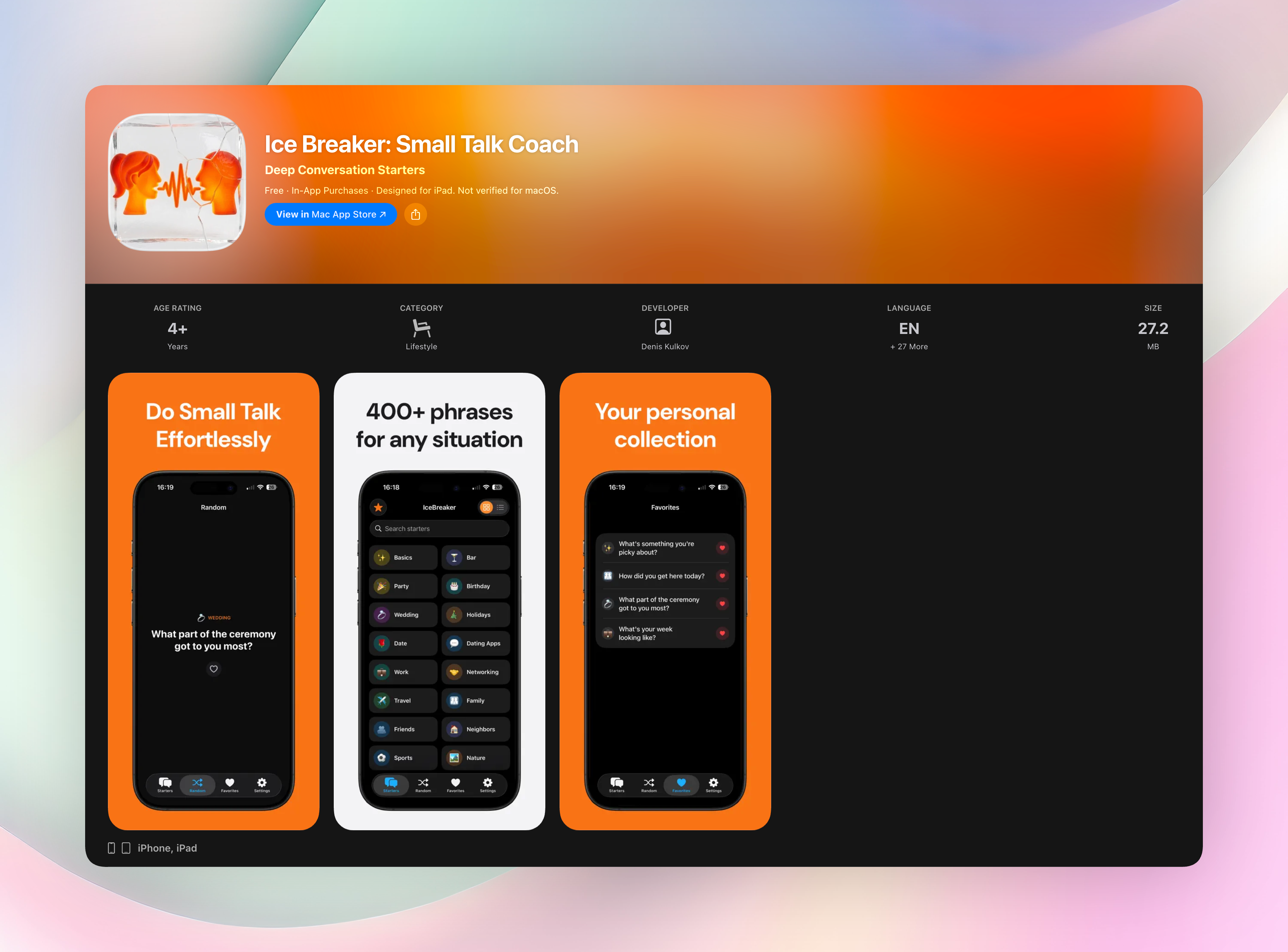
For pulling get to know you questions up quickly without flipping through notes, Ice Breaker is a free app with 480 conversation starters across 16 categories, with a favorites list for the ones your group responds to best.
FAQ
What are good get to know you questions for a new group?
Questions that ask about preferences and small personal details — a favorite hobby, a go-to order, something someone's proud of — work well because they're easy to answer without requiring real vulnerability from people who don't know each other yet.
What are some easy icebreaker games for adults?
Two Truths and a Lie, Would You Rather, and Human Bingo are all reliable formats because they add a light game structure around the questions, which takes the pressure off answering "correctly" and makes participation feel optional rather than mandatory.
What get to know you questions work for family gatherings?
Questions that invite a story rather than an opinion tend to work best across generations — asking about a favorite memory or a piece of advice someone's received usually lands better than a question that could turn into a debate.
How do I get a shy group to open up with these questions?
Start with lighter, lower-stakes questions and let the facilitator answer first to set the tone. Giving people an easy way to pass also helps — paradoxically, it usually makes people more willing to share once they know they're not cornered.
Should get to know you questions be the same for kids and adults?
Not exactly — kids tend to respond well to imaginative, low-pressure prompts (favorite animal, dream superpower), while adult groups usually get more out of questions tied to preference, values, or experience. The format (go-around, light game structure) works for both, even when the specific questions don't overlap.
Free Ice Breaker tools
- Conversation Starter GeneratorChoose your relationship, setting, and tone to get a low-pressure opener plus a natural follow-up question.
- Get to Know You Worksheet MakerChoose a group, audience, depth and question count. Add your own prompts or use the visible built-in question bank.
- How Well Do They Know Me Quiz MakerChoose a group, category, difficulty and question count. Add personal questions or use the visible built-in bank.
- Icebreaker GeneratorChoose your group, headcount, and time window to get a practical icebreaker with simple instructions and a realistic duration.
- Social Intelligence TestReflect on eight everyday scenarios to see practice scores for cue recognition, listening, conversational reciprocity, and response choice.