
Conversation starters for any situation
A good conversation starter is specific, open-ended, and low-stakes — it gives the other person something easy to react to instead of a yes/no dead end. The right one depends on the room: a networking event calls for a different opener than a first date or a family dinner.
What makes a good conversation starter?
Most conversation starters fail for one of two reasons: they're too generic to react to, or they're too personal for a stranger. "How's it going?" gets a one-word answer because there's nothing in it to grab onto. A question about someone's actual dating history five minutes after meeting them skips past the trust that hasn't been built yet.
Great conversation starters split the difference. They're specific enough to invite a real answer, but light enough that answering costs the other person nothing. "What's the story behind that?" pointing at a pin on someone's bag works because it's about an object, not them personally — it's an easy entry point that can go anywhere.
A few traits show up in almost every opener that actually lands:
- It's answerable in one sentence or a paragraph — the other person chooses how much to give.
- It references something present — the room, the event, an object, the weather, the moment you're both in.
- It's not a test. Trivia questions and "gotcha" openers put people on the spot instead of inviting them in.
- It leaves room for a follow-up. A starter that dead-ends after one exchange isn't doing its job; the best ones open a thread you can pull on.
The best conversation starters also match your own energy. A line that sounds natural coming from someone upbeat and playful can sound forced coming from someone reserved, and vice versa. Borrow the structure of an opener, not the exact wording, and it'll come out sounding like you instead of a script.
Read the room before you pick one
Context does most of the work before you say a word. The same line that kills at a party can fall flat at a work conference, and a question that's warm at a family gathering can feel invasive between two strangers at a bus stop. Before reaching for an opener, it helps to clock three things: how much time you both actually have, how formal the setting is, and whether the other person looks open to being approached (facing outward, making eye contact, not deep in a phone or a conversation already).
| Setting | Time available | What tends to work | What to skip |
|---|---|---|---|
| Party or bar | Open-ended | Playful, situational ("How do you know the host?") | Overly serious or personal questions |
| Networking event | Short, interruptible | Work-adjacent but not just "what do you do" | Pitching yourself before they've asked |
| First date | Extended, one-on-one | Curious, a little personal, low-pressure | Rapid-fire interview questions |
| Family gathering | Extended, recurring | Updates, shared history, light opinions | Politics, money, old arguments |
| Waiting in line / elevator | Very short | Observational, about the shared moment | Anything requiring a long answer |
| Coworker / new hire | Repeated, ongoing | Work context first, personal later | Getting too personal too fast |
None of these are hard rules — plenty of good conversations break the pattern — but they're a reasonable default when you're not sure what the room wants.
Conversation starters for specific situations, explained
The table above is a quick reference. Here's the reasoning behind each setting, because the why is what lets you improvise once you're actually in the moment.
Parties and bars
The easiest entry point at a party is the shared context: how you both know the host, what drew you to this particular gathering, or a comment about the space itself. Groups are more approachable than they look — walking up to a group of three or four and asking a light, situational question ("Is this the good corner of the party or did I pick wrong?") usually gets an easier reception than you'd expect, because you're addressing the group rather than singling anyone out.
Networking events
The instinct at a networking event is to lead with your own pitch. Resist it. Asking a genuine question about the other person's work — what they're building, what brought them to the event, what they're hoping to get out of it — puts them at ease and usually earns you the same curiosity back. Business cards and LinkedIn requests belong at the end of the conversation, not the start of it.
First dates
A first date benefits from starters that are personal but not probing — questions about preference, mood, and interest rather than history or plans. "What's been the best part of your week" works better early on than "where do you see this going," because it invites a story instead of demanding a commitment. Save the heavier, more vulnerable questions for once you're both clearly comfortable.
Coworkers and new hires
New-hire small talk works best anchored to something concrete: the role, the team, the first-week logistics. Once that's established, personal questions ("what do you like to do outside of work") feel like a natural next step rather than an overstep. With existing coworkers, shared-context openers — a project update, an office event, a running joke — tend to land better than personal questions out of nowhere.
Family gatherings
Family conversations carry history that strangers don't, which is exactly why neutral, forward-looking questions work better than the ones that reopen old topics. Asking about a recent trip, a hobby someone's picked up, or what they're looking forward to keeps things warm without wandering into territory that's caused friction before.
Casual conversation starters for everyday situations
These are the openers for the small, unplanned moments: waiting rooms, coffee lines, elevators, dog parks, the gym.
- "Have you tried [the thing everyone's ordering/waiting for] before? Worth it?"
- "This line is no joke — you been here before, or is this your first time?"
- "I love your [jacket/bag/shoes] — where's that from?"
- "Is this seat/spot taken?" followed by something situational once they say no.
- "What's good here? I'm trying to decide."
- "Rough day, or is it just me?" — said lightly, with a smile, works better than it sounds on paper.
The common thread is that each one points at something in the shared environment. That's what makes casual conversation starters easy to use on strangers: you're not asking them to reveal anything about themselves yet, just to react to the moment you're both already in.
Deeper conversation starters, once small talk has landed
Once the initial exchange is comfortable — a few sentences back and forth, some eye contact, maybe a laugh — you can move past logistics into something with more texture.
- "What's been the best part of your week so far?"
- "What do you do when you're not at work?" (a warmer version of "what do you do")
- "What's something you've gotten really into lately?"
- "Is this your kind of scene, or are you more of a homebody?"
- "What brought you to [the city/event/group]?"
- "What's a small thing that's made you happy recently?"
These work because they ask about preference and experience rather than fact. "What do you do for work" gets a job title; "what do you do when you're not working" gets a person.
Funny and lighthearted conversation starters
Humor lowers the stakes fast — a shared laugh signals that neither of you is taking the interaction too seriously, which makes it easier to keep going. It works best when it's self-deprecating or observational rather than aimed at the other person.
- "Okay, I need a second opinion: is this music good, or am I just old now?"
- "If you had to survive on one food from this buffet forever, what are you picking?"
- "I'm going to guess your coffee order. No pressure, but my reputation's on the line."
- "What's the most useless talent you have?"
- "Be honest — how many times did you almost not come tonight?"
Funny openers carry more risk than earnest ones because tone matters so much; a joke that lands as playful from one person can read as sarcastic from another. If you're not sure your delivery will land, a warm, curious question is the safer bet.
Universal conversation starters for when you blank
Some moments call for a starter that works almost anywhere, because you don't have time to customize one — you just need something in your back pocket.
- "What's your story with this place?"
- "What's something you're looking forward to?"
- "Any recommendations for [something relevant to where you are]?"
- "What's the best thing that's happened to you this week?"
- "How do you two know each other?" (aimed at a group, not just one person)
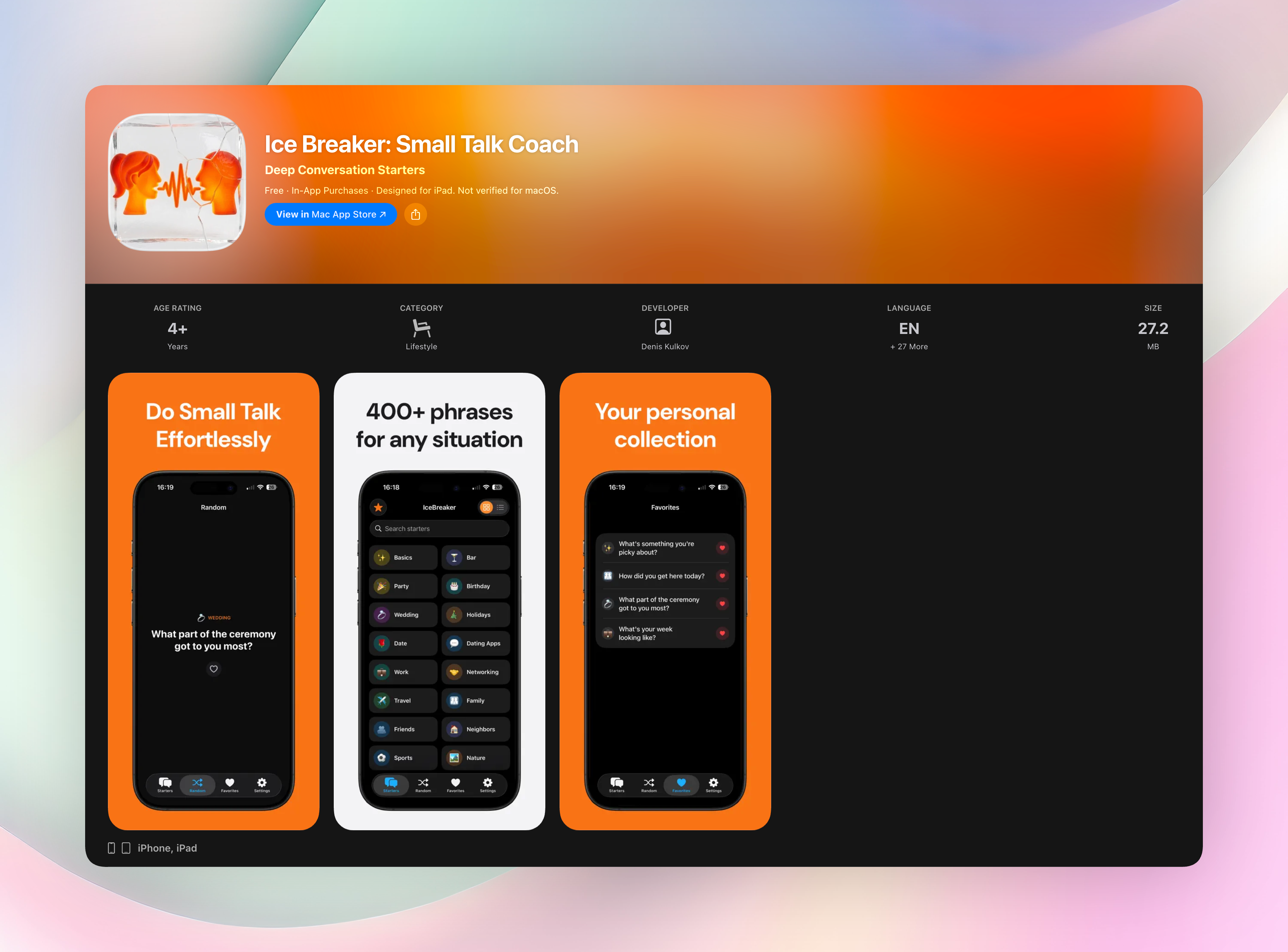
If you'd rather have a stash of these ready than try to invent one on the spot, Ice Breaker is a free app with 480 conversation starters sorted into 16 categories, plus offline access and a favorites list for the ones that keep working for you.
Keeping it from being a one-and-done exchange
A conversation starter's only job is to open the door. What keeps someone talking is what you do with their answer. The simplest habit is to pull one detail out of what they just said and ask about it — if someone mentions they just got back from a trip, ask what the best part was, not "that's cool" and a topic change. Following the thread they already handed you feels more natural than switching to a new question, and it signals you were actually listening rather than waiting for your turn to talk.
It's fine if a starter doesn't land. Not every opener gets a warm response, and that's usually about timing or mood rather than the question itself. A short, easy exit ("No worries, enjoy your night") costs nothing and leaves the door open for a better moment.
Conversation starters to avoid
A few categories reliably backfire, no matter how good the delivery:
- Yes/no questions ("Do you come here often?") that hand the other person an easy exit.
- Compliments about the body — they read as evaluative even when meant kindly.
- Anything that requires the other person to defend a choice ("Why would you order that?").
- Interview-style stacking — three questions in a row before they've finished answering the first.
- Topics with an obvious wrong answer — politics, religion, and money with someone you've just met tend to create more friction than connection.
FAQ
What are some good conversation starters?
Good conversation starters are specific and easy to react to — a question about something in the shared moment (an event, an object, the setting) rather than a generic "how's it going." Comment-then-question also works well: notice something out loud, then ask about it.
What's the best conversation starter for a stranger?
An observational question about your shared environment is usually the safest bet — it asks nothing personal yet, gives the other person an easy way in, and naturally opens the door to a follow-up.
How do I start a conversation without sounding awkward?
Keep it short, reference something present, and deliver it like a normal comment rather than a rehearsed line. Awkwardness usually comes from overthinking the wording, not from the question itself — a simple, genuine line beats a clever one you're not confident saying.
What conversation starters should I avoid?
Skip yes/no questions, anything that puts the other person on the spot, and topics like politics or money with someone you don't know well. These tend to close a conversation down rather than open it up.
How many conversation starters should I have ready?
You don't need a script — two or three flexible openers that fit different settings (one observational, one about preferences, one lighthearted) cover most situations. The goal is a starting point, not a full plan for the conversation.
Free Ice Breaker tools
- Conversation Starter GeneratorChoose your relationship, setting, and tone to get a low-pressure opener plus a natural follow-up question.
- Get to Know You Worksheet MakerChoose a group, audience, depth and question count. Add your own prompts or use the visible built-in question bank.
- How Well Do They Know Me Quiz MakerChoose a group, category, difficulty and question count. Add personal questions or use the visible built-in bank.
- Icebreaker GeneratorChoose your group, headcount, and time window to get a practical icebreaker with simple instructions and a realistic duration.
- Social Intelligence TestReflect on eight everyday scenarios to see practice scores for cue recognition, listening, conversational reciprocity, and response choice.