
How to make friends as an adult
How to make friends as an adult comes down to deliberate effort, because the structures that built friendships automatically — school, dorms, shared schedules — are gone. The fix is putting yourself in situations with repeated, low-stakes contact and doing the small, unglamorous work of following up.
How to make friends as an adult: why it's harder now
Childhood and college friendships form almost by accident. You're placed in the same room as the same people, day after day, for years — a classroom, a dorm hallway, a lunch table — and friendship grows out of sheer repeated exposure with almost no effort required. Just seeing the same face regularly, with no pressure attached, tends to build familiarity and comfort on its own.
Adulthood removes nearly all of that scaffolding. Work is transactional and often remote or hybrid. Neighbors are strangers by default. Most social contact has to be actively scheduled rather than stumbled into. And it's not just the structure — it's also that the stakes feel higher. As a kid, striking up a friendship costs nothing; as an adult, everyone's calendar is already full, which makes asking someone to hang out feel like you're asking for a favor rather than offering a mutual invitation.
There's also a numbers problem. Adult life shrinks the pool of people you see repeatedly. A twenty-two-year-old sees dozens of classmates daily; a thirty-five-year-old working from home might see the same five coworkers on video calls and nobody else with any regularity. Fewer repeated contacts means fewer chances for a passing acquaintance to turn into something more.
None of this means adult friendship is impossible — it means it needs to be engineered rather than left to happen on its own.
Where to actually meet people
The common thread across every reliable way to meet people as an adult is repetition: you need to see the same faces more than once, ideally on a recurring schedule, because a single encounter rarely produces a friendship on its own.
- Recurring classes — a weekly climbing session, pottery class, or language course puts you in a room with the same people on a schedule, which does the repeated-exposure work for you.
- Sports leagues and recreational teams — adult rec leagues (soccer, volleyball, run clubs) combine repetition with a shared, low-stakes goal, which tends to produce friendships faster than passive social settings.
- Volunteering — regular volunteer commitments put you next to people who already share at least one value with you, which gives conversations a head start.
- Work, used deliberately — coworkers won't become friends automatically just from proximity anymore, especially remote ones, but consistently showing up to optional social moments (lunch, coffee, after-work events) turns passive coworkers into active ones.
- Interest-based apps and meetup groups — apps built around a specific activity (hiking groups, book clubs, board game nights) filter for shared interest before you even show up, which removes some of the awkwardness of finding common ground from scratch.
- Neighbors and recurring local spots — a regular coffee shop, gym, or dog park works the same way a classroom used to: same faces, same schedule, gradual familiarity.
The format matters less than the recurrence. A one-off event might produce a nice conversation, but a recurring one gives that conversation somewhere to go.
Why small talk is the real mechanism
Small talk gets dismissed as filler, but it's actually the mechanism that turns a stranger into an acquaintance, and an acquaintance into a friend. Nobody becomes close friends with someone they've never had a low-stakes conversation with first — the deep conversations that define real friendship almost always follow a series of small ones that built enough trust to get there.
This is why showing up once to a class or league rarely produces a friendship on its own. The first small talk exchange establishes that you're both safe and pleasant to talk to. The second and third build familiarity. Somewhere around the fourth or fifth low-stakes conversation, it usually starts to feel natural to suggest something outside the original context — grabbing coffee after class, or exchanging numbers after the game. Small talk isn't a detour on the way to friendship; it's the road itself.
This is also why picking recurring activities over one-off events matters so much: it gives small talk the repetition it needs to compound into something bigger.
Use the friends you already have
One of the most efficient ways to make friends as an adult is through people you already know, rather than starting entirely from strangers. Asking an existing friend to bring you to their recurring thing — a game night, a group hike, a birthday dinner — gives you an instant, lower-stakes way into a new group, because you arrive with a built-in connection rather than as a total unknown. It also works in reverse: hosting something small and inviting a few existing friends, each of whom might bring someone new, tends to expand your circle faster than trying to build every connection from scratch.
This kind of second-degree connection — a friend of a friend — also tends to feel less risky to approach, since there's already a shared point of trust to reference in that first conversation.
Common mistakes that stall new friendships
A few habits quietly get in the way of turning acquaintances into real friends:
- Expecting closeness after one hangout. Real friendship almost always takes several rounds of contact — treating the first coffee or dinner as a verdict on whether the friendship "worked" sets an unrealistic bar.
- Only reaching out when you need something. A friendship built entirely on favors or venting sessions feels transactional rather than mutual over time.
- Waiting for the other person to initiate every time. If you never suggest plans, the relationship quietly depends on someone else doing all the work — and it usually stalls.
- Not following through on plans that get made. Adult schedules are genuinely tight, but flaking repeatedly signals the friendship isn't a priority, even when that's not the intent.
- Skipping the low-stakes stage. Trying to go deep too fast — heavy personal topics before the relationship has had time to build trust — can feel like too much, too soon, even to someone who'd otherwise be a good friend.
Turning an acquaintance into an actual friend
Meeting people is only half of it — plenty of friendly acquaintances never turn into real friendships because nobody takes the small next step. A few things that reliably move the relationship forward:
- Be the one to suggest something outside the original context. "Want to grab coffee before class next week?" moves the relationship from "person I see at pottery" to "person I hang out with."
- Follow up on specific details. If someone mentioned a trip or a work deadline, asking about it the next time you see them shows the relationship is more than situational.
- Initiate more than once. One invitation that doesn't pan out (scheduling conflicts happen) isn't a rejection — it's worth trying again before assuming there's no interest.
- Lower the bar for hanging out. A casual, low-commitment invite ("a few of us are getting food after, if you're free") is easier to say yes to than a formal one-on-one ask, especially early on.
- Accept that some won't go further. Not every recurring acquaintance becomes a close friend, and that's fine — the goal is a handful of real connections, not converting every friendly face into a friendship.
Talking to strangers without it feeling weird
Making friends as an adult almost always starts with talking to strangers, which is the part most people find hardest. A few things make it easier in practice:
- Lead with the shared context, not yourself. "How long have you been coming to this class?" is easier to say and easier to answer than introducing yourself out of nowhere.
- Keep the first exchange short and low-pressure. You're not trying to become friends in one conversation — you're just establishing that a second conversation would be welcome.
- Expect it to feel a little awkward at first. That fades with repetition much faster than it seems like it will the first few times.
- Show up consistently. Familiarity does a lot of the social work for you — the fifth time you see the same person, starting a conversation takes noticeably less effort than the first.
For the mechanics of actually keeping that first conversation going once you've started it, see how to keep a conversation going — the follow-up-question habit described there is exactly what turns a stranger's polite reply into an actual exchange.
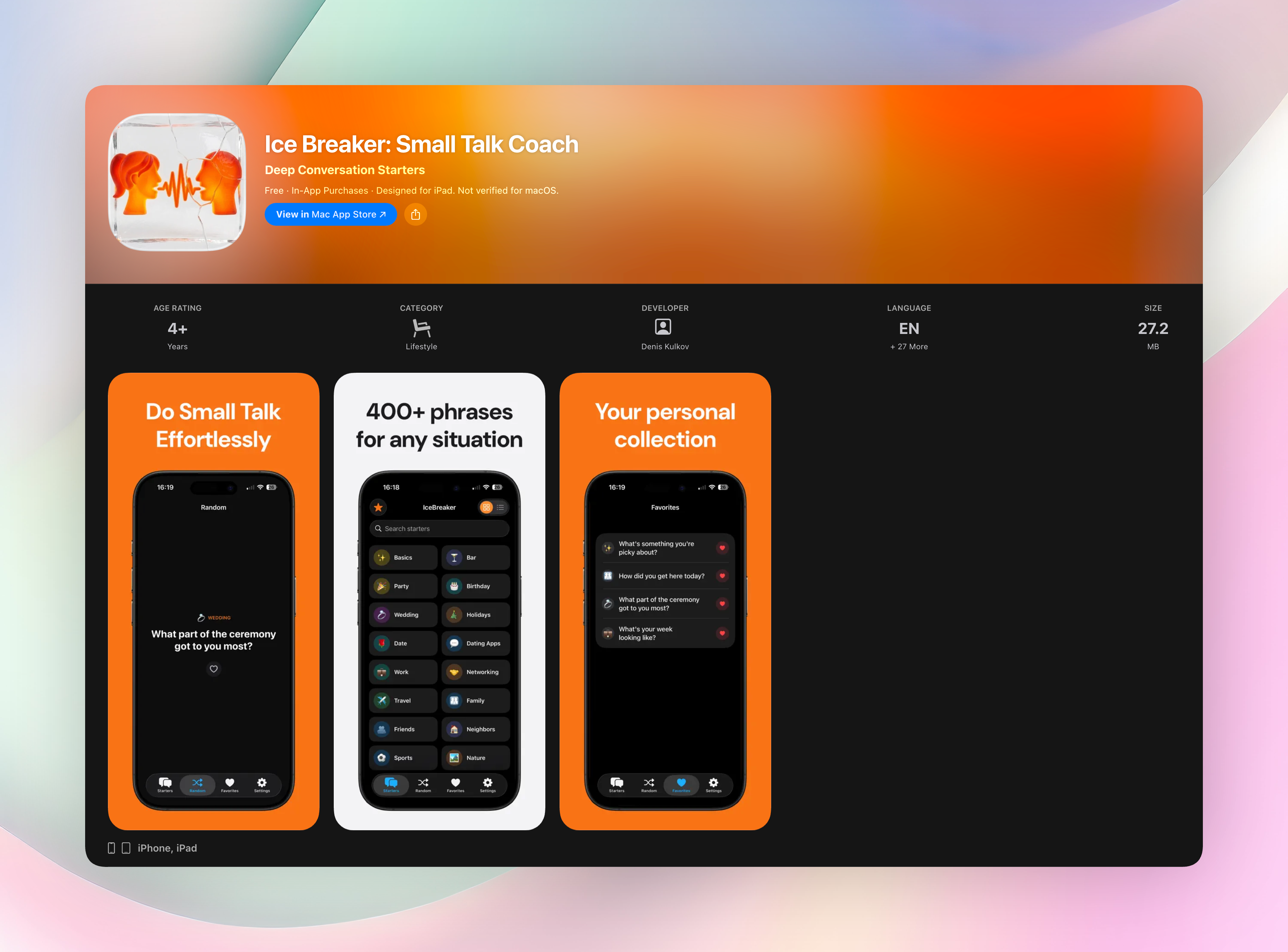
If you tend to blank on what to say when you're the one who has to start the conversation, Ice Breaker is a free app with 480 conversation starters across 16 categories, so you have something ready to open with instead of hoping a line comes to you on the spot.
FAQ
Why is it so hard to make friends as an adult?
Adult life removes the structures — school, dorms, shared daily schedules — that used to produce friendships through sheer repeated exposure. Without that built-in repetition, friendship has to be actively engineered through recurring activities rather than left to happen on its own.
Where's the best place to make friends as an adult?
Anywhere that puts you in front of the same people on a recurring schedule — a class, a sports league, a volunteer group, or a regular meetup — tends to work better than one-off events, because friendship needs repeated contact to build.
How long does it take to make a real friend as an adult?
There's no fixed timeline, but it usually takes several low-stakes interactions — small talk repeated over weeks or months — before a relationship naturally extends beyond the original context. Consistency matters more than any single conversation.
How do I talk to strangers without it feeling awkward?
Lead with something about the shared context rather than introducing yourself cold, keep the exchange short, and expect a little awkwardness at first — it fades quickly with repetition, especially if you keep showing up to the same recurring setting.
Is it normal to not have many close friends as an adult?
Yes — most adults see their social circle narrow after school and early adulthood, largely because the automatic structures for meeting people disappear. It's common, and it's also reversible with deliberate effort rather than a sign that something's wrong.
Free Ice Breaker tools
- Conversation Starter GeneratorChoose your relationship, setting, and tone to get a low-pressure opener plus a natural follow-up question.
- Get to Know You Worksheet MakerChoose a group, audience, depth and question count. Add your own prompts or use the visible built-in question bank.
- How Well Do They Know Me Quiz MakerChoose a group, category, difficulty and question count. Add personal questions or use the visible built-in bank.
- Icebreaker GeneratorChoose your group, headcount, and time window to get a practical icebreaker with simple instructions and a realistic duration.
- Social Intelligence TestReflect on eight everyday scenarios to see practice scores for cue recognition, listening, conversational reciprocity, and response choice.