
How to make small talk
How to make small talk comes down to four moves: read the room, open with something specific and low-stakes, keep it going by asking about what the other person just said, and notice when it's time to wrap up. None of it requires being naturally outgoing — it's a sequence you can follow deliberately.
How to make small talk: step 1, read the room
Before you say anything, take stock of the situation. Is the other person open to being approached — facing outward, not deep in their phone, not mid-conversation with someone else? How much time do you realistically have — a two-minute elevator ride or an open-ended party? How formal is the setting? These three answers shape everything that follows. An opener that's perfect for a networking event ("What brought you to this event?") will feel oddly formal at a backyard barbecue, and one that's fine at a party ("Nice shoes — where are those from?") can read as too casual in a boardroom.
If you're unsure whether someone wants to be approached, a light, easily declinable opener is the safer move — something they can answer in one word without it feeling rude, giving them a low-pressure way to signal whether they want to keep going.
Groups take a slightly different read than individuals. A group standing in a loose circle, making eye contact with people walking by, is generally more open to a new person joining than a tight, closed-off huddle leaning in toward each other. When approaching a group, address the group rather than singling one person out — it lowers the pressure on everyone and makes it easy for whoever wants to respond to jump in.
Common mistakes that stall small talk
A handful of habits account for most small talk that fizzles out fast:
- Answering with one word yourself. If you ask a question and then give one-word replies to theirs, you're modeling the exact behavior you don't want back. Match the effort you're hoping to get.
- Rehearsing your next line instead of listening. It's tempting to plan your next question while the other person is still talking, but it means you miss the actual detail worth following up on.
- Treating it like an interview. A string of unrelated questions with no follow-up or personal reaction feels more like a survey than a conversation.
- Over-apologizing for approaching. A quick, confident opener reads better than one buried in "sorry to bother you, this is probably weird, but—." The hedging draws more attention to the interruption than the interruption itself.
- Forcing it when the signal says no. If someone gives short, closed answers and doesn't reciprocate with a question of their own, it's usually not personal — timing and mood matter more than most people assume. A graceful exit beats pushing for a connection that isn't there today.
Step 2: Choose an opener that's specific, not generic
The most common reason small talk stalls immediately is a generic opener that gives the other person nothing to react to. "How's it going?" invites "good, you?" and then silence. A better opener references something specific and present: the event, the setting, an object, a shared moment.
A few patterns that tend to work across most situations:
- Comment, then question. Notice something out loud, then ask about it: "This line is taking forever — you been here before?"
- Ask about their connection to the setting. "How do you know the host?" "What brought you to this conference?"
- Compliment, then ask. "I love that bag — where's it from?" works better than a bare compliment because it hands them something to answer.
- Ask their opinion on something shared. "Is this your kind of music, or are you being polite?"
If you want a longer list to pull from depending on where you are, our guide to conversation starters for any situation breaks openers down by setting — parties, dates, work events, and more.
Step 3: Keep it going with the follow-up-question habit
This is the step most people skip, and it's the one that actually determines whether small talk turns into a real conversation. After the other person answers, resist the urge to respond with just an acknowledgment ("cool," "nice") and change the subject. Instead, pull one detail from what they said and ask about it.
If someone mentions they just moved to the city, don't just say "oh nice" — ask what brought them here, or what's surprised them so far. If they mention a busy week, ask what's been keeping them busy. This is sometimes called "threading": each answer contains a thread you can pull, and following it signals you were actually listening rather than waiting for your turn to talk.
A simple mental habit that makes this easier: after they answer, silently ask yourself "what's one thing in that answer I could ask more about?" before you respond. It slows you down just enough to actually engage with what they said instead of reaching for your next planned question.
Avoid stacking multiple questions in a row without letting the conversation breathe — it starts to feel like an interview rather than a conversation. One follow-up, a beat to let them expand, then a natural next question works better than a rapid-fire list.
Step 4: Notice the signal to wrap up
Small talk has a natural shelf life, and pushing past it is one of the more common ways it turns awkward. A few signs the conversation has run its course: answers getting shorter, less eye contact, body angling away, or a lull that neither person is filling with real curiosity. None of these mean the conversation went badly — most small talk is supposed to be short.
When you notice the signal, a short, warm exit works better than trailing off: "It was great chatting — enjoy the rest of the party" or "I should let you get back to it, good talking to you." Ending cleanly leaves a better impression than a conversation that fizzles into an awkward silence before someone finally walks away.
If the conversation went well and you'd like to keep the connection going, this is also the moment to say so directly — "Would you want to grab a coffee sometime?" or exchanging a way to stay in touch. Waiting until after you've already parted ways to think of it usually means the moment's passed.
How to get better at small talk over time
How to get better at small talk isn't really about learning more lines — it's about reps. The awkwardness of small talk fades with practice the same way any social skill does; the fifth conversation with a stranger this month will feel noticeably easier than the first one did. A few ways to build that practice without much pressure:
- Start with low-stakes strangers — a barista, a cashier, someone in a line — where the interaction has a built-in exit and nothing is riding on it.
- Set a small, specific goal rather than "be better at talking to people." Something like "ask one follow-up question today" is concrete enough to actually notice yourself doing it.
- Debrief briefly afterward. Not a full analysis — just noticing what worked ("the observational opener landed well") builds the pattern faster than replaying what felt awkward.
- Expect some flat conversations. Not every opener lands, and that's normal — it's about the other person's mood and timing as much as anything you did.
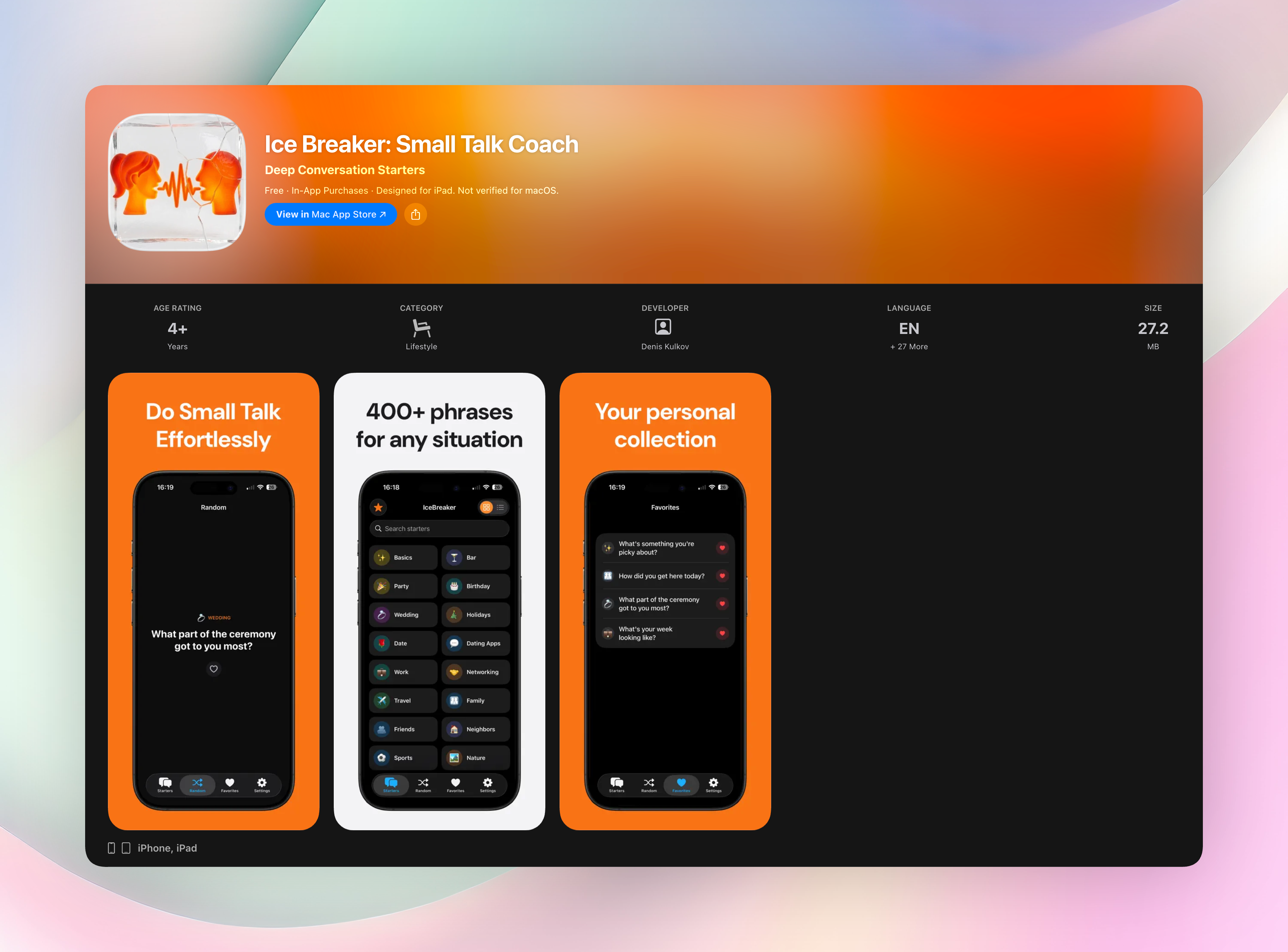
If you tend to blank on what to say in the moment, having a few reliable openers on hand takes the pressure off improvising from scratch. Ice Breaker is a free app with 480 conversation starters across 16 categories, so you can glance at one before walking into a room instead of hoping something comes to mind.
FAQ
How do I initiate small talk with a stranger?
Start with something specific and present — a comment about the shared setting followed by a question — rather than a generic greeting. It gives the other person something easy to react to and signals you're paying attention, not just filling silence.
What do I say after the small talk opener?
Ask a follow-up question about something specific in their answer instead of just acknowledging it and moving on. That single habit is what usually turns a stiff exchange into an actual conversation.
How can I get better at small talk if I'm naturally quiet?
Practice with low-stakes strangers where the stakes are near zero — a cashier, someone in a line — and set a small, concrete goal like asking one follow-up question. The discomfort fades with repetition faster than most people expect.
How do I know when to end a small talk conversation?
Watch for shorter answers, less eye contact, or body language angling away — these usually mean the conversation has run its natural course. A short, warm exit line works better than letting it trail off into silence.
What's the biggest small talk mistake people make?
Asking a question and then not following up on the answer. It turns the exchange into a series of disconnected questions instead of a conversation, and it's the fastest way to make small talk feel like an interview.
Free Ice Breaker tools
- Conversation Starter GeneratorChoose your relationship, setting, and tone to get a low-pressure opener plus a natural follow-up question.
- Get to Know You Worksheet MakerChoose a group, audience, depth and question count. Add your own prompts or use the visible built-in question bank.
- How Well Do They Know Me Quiz MakerChoose a group, category, difficulty and question count. Add personal questions or use the visible built-in bank.
- Icebreaker GeneratorChoose your group, headcount, and time window to get a practical icebreaker with simple instructions and a realistic duration.
- Social Intelligence TestReflect on eight everyday scenarios to see practice scores for cue recognition, listening, conversational reciprocity, and response choice.