
How to keep a conversation going
How to keep a conversation going comes down to one repeatable move: take a detail from what the other person just said and ask about it, instead of responding with a flat acknowledgment. Do that consistently, pay attention to their energy, and you'll rarely run out of things to say.
How to keep a conversation going: start with active listening
Most advice about keeping a conversation going focuses on what to say next, but the real skill happens while the other person is still talking. Active listening means giving them your full attention instead of half-listening while you plan your next line — and it's the only way to catch the details worth following up on.
A few concrete habits make this easier:
- Don't formulate your response while they're still mid-sentence. It's tempting, but it means you're processing your own words instead of theirs, and you'll miss the thread that would have kept things going.
- React before you redirect. A short, genuine reaction — "wait, really?" or "that's rough" — before your next question shows you actually heard them, not just that you're waiting for your turn.
- Notice what they emphasize. People tend to linger, however briefly, on the part of their answer that matters most to them. That's usually the better thread to pull than the first thing they mentioned.
The follow-up-question loop
This is the single habit that does the most work in keeping a conversation going. After someone answers a question, pick one specific detail from their answer and ask about it, rather than moving to a new, unrelated topic.
If someone says "work's been busy, I just started a new project," there are several threads available: what the project is, whether busy is good-busy or bad-busy, how long they've been at the company. Pick one and follow it. The conversation naturally builds a chain — each answer feeds the next question — instead of feeling like a list of disconnected topics.
A simple structure to fall back on:
- Ask a question.
- Listen for a detail that has some weight to it — something they said with a little more energy or specificity than the rest.
- Ask about that detail specifically, rather than a generic "tell me more."
- Add a small reaction or a related thought of your own before your next question, so it doesn't feel like an interrogation.
This loop is what separates a conversation that runs for twenty minutes from one that dies after the opener. For more on the technique behind starting that loop in the first place, see how to make small talk.
Reading energy and interest signals
Not every follow-up needs to keep going — part of keeping a conversation alive is noticing when a particular thread has run dry and it's time to pivot rather than dig deeper. A few signals worth watching:
- Answer length. Short, flat answers on a topic usually mean it's not landing — time to pivot, not push harder.
- Reciprocal questions. If they're asking you things back, that's a strong sign of genuine engagement. If it's one-sided for a while, the energy may be lower than it seems.
- Body language. Leaning in, facing you directly, and sustained eye contact usually mean they're engaged; checking a phone, scanning the room, or angling away usually mean the opposite.
- Tone shift. A subject that gets someone visibly more animated — talking faster, gesturing more — is worth staying on longer than the topic that got a flat, polite response.
If you consistently get low-energy signals across several different topics, it may just be a mismatch in mood or timing rather than anything you're doing wrong — some conversations simply don't have much momentum, and that's normal.
What to do when the conversation stalls
Every conversation hits at least one lull. The instinct is often to panic and grab for anything, but a stalled conversation usually just needs a pivot rather than an entirely new start.
- Pivot to an adjacent topic. If work talk has run dry, ask about their weekend, a hobby, or their plans — related enough to feel natural, different enough to have fresh material.
- Use the room. A comment about the environment — something that's changed, something new happening around you — is a low-effort restart that doesn't require inventing a new subject from scratch.
- Ask a bigger-picture question. "What's been the best part of your week?" or "What are you looking forward to?" tend to open more territory than a narrow follow-up.
- Name the lull lightly, if it fits the tone. A relaxed "okay, I've officially run out of small talk" can actually be disarming and often gets a laugh and a new topic in return.
If you find yourself stalling out often, it can help to have a mental list of go-to topics ready rather than trying to invent one under pressure — our guide to small talk topics breaks down categories that reliably work.
Keeping a group conversation going
Group conversations follow slightly different rules than one-on-one ones. The follow-up-question loop still applies, but it works best when you occasionally direct a question at someone who's gone quiet rather than only following up with whoever's already talking most. A simple, low-pressure way to do this is to reference something they mentioned earlier — "Wait, didn't you say you'd been there too?" — which pulls them back in without putting them on the spot with an open-ended question out of nowhere.
It also helps to resist the urge to fill every pause yourself. In a group, silence doesn't land as awkwardly as it does one-on-one, because there's no single person expected to fill it. Giving a beat before jumping in often gives someone quieter the opening to add something they'd otherwise have missed.
How to end a conversation politely
Knowing how to end a conversation politely matters just as much as knowing how to keep one going — a conversation that trails off into an awkward silence leaves a worse impression than one that ends cleanly on purpose. A few ways to close it out:
- The direct, warm exit. "It was great talking to you — I'm going to go say hi to a few more people." Honest, doesn't require an excuse.
- The forward-looking close. "I'd love to keep talking — are you on [social platform/at this thing regularly]?" works when you want to leave the door open.
- The logistical out. "I should grab a drink before the line gets long, but this was great." Gives a concrete, low-drama reason to step away.
- The summary close. Briefly recapping something they said ("Good luck with the move, hope it goes smoothly") signals the conversation is wrapping up while showing you were listening the whole way through.
The key to ending a conversation politely is doing it with intention rather than just letting your attention visibly wander. A conversation that ends on a clear, warm note is remembered far better than one that just fades out.
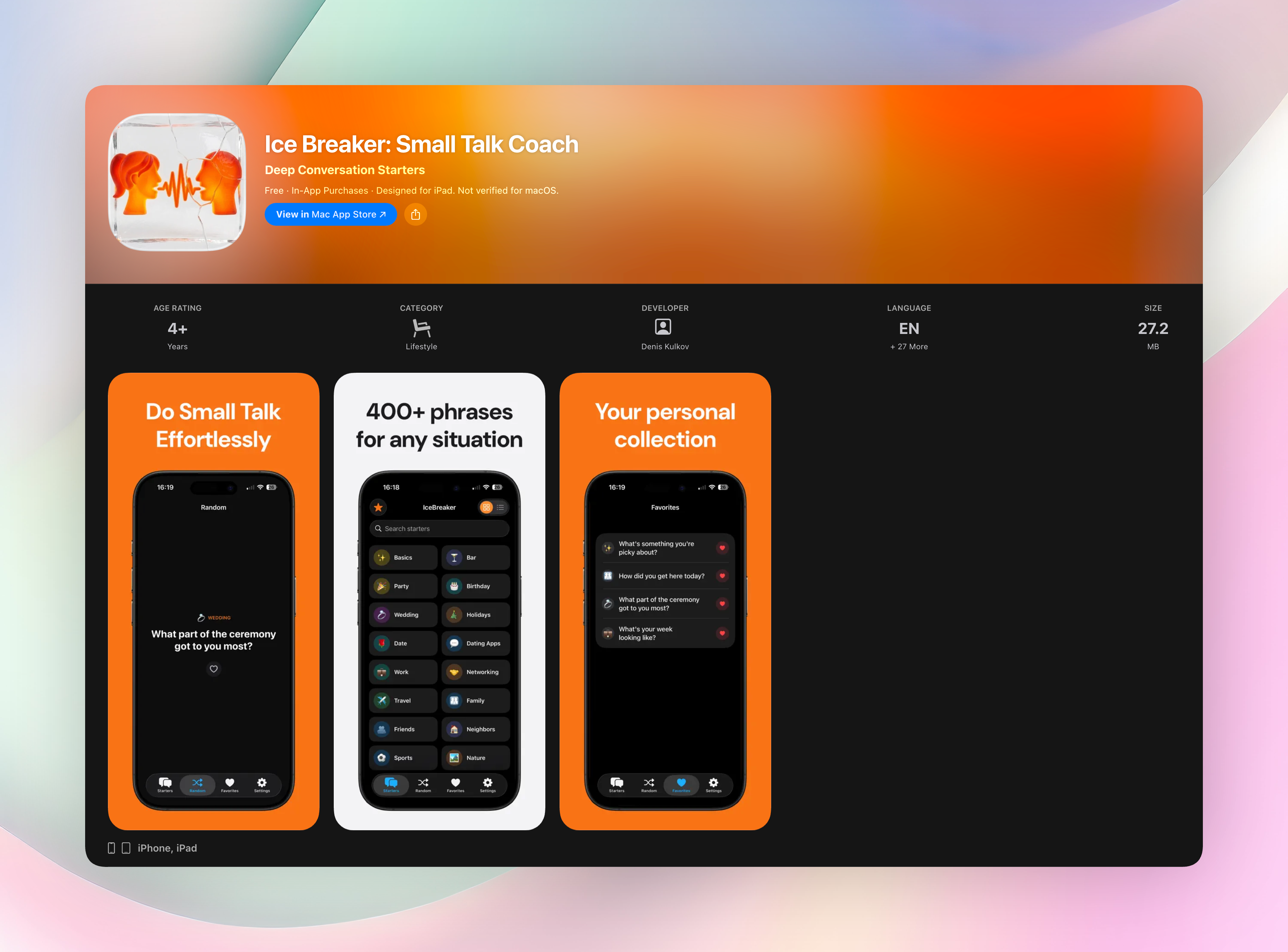
If you tend to run out of things to say mid-conversation, having a few topics or questions on hand can take the pressure off improvising one under pressure. Ice Breaker is a free app with 480 conversation starters across 16 categories and a favorites list, so you always have a next question ready if the thread runs dry.
FAQ
How do I keep a conversation from dying out?
Follow up on a specific detail in whatever the other person just said, rather than responding with a flat acknowledgment and changing the subject. This one habit does more to sustain a conversation than any list of topics.
What do I do when there's an awkward silence?
A short silence isn't actually a crisis — it's normal in most conversations. If it stretches on, pivoting to something in the environment or asking a bigger-picture question ("What's been the best part of your week?") usually restarts it without feeling forced.
How do I end a conversation politely without being rude?
Give a warm, direct close rather than letting your attention drift — something like "It was great talking to you, I'm going to go grab a drink" works, because it's honest and doesn't require inventing an elaborate excuse.
How do I know if someone wants to keep talking to me?
Watch for reciprocal questions, sustained eye contact, and longer, more detailed answers — these usually mean genuine engagement. Short answers and a lack of questions back tend to mean the energy is lower, which is worth respecting rather than pushing past.
Why do my conversations always feel one-sided?
If you're doing most of the follow-up work and getting little back, it's often a mismatch in energy or timing rather than something wrong with your approach — try pivoting to a topic where the other person clearly has more to say, or gracefully wrap up if the mismatch continues. It's also worth remembering that being the one to end a conversation isn't rude — a clear, warm close is more considerate than letting it drift into silence while both people wait for the other to leave first.
Free Ice Breaker tools
- Conversation Starter GeneratorChoose your relationship, setting, and tone to get a low-pressure opener plus a natural follow-up question.
- Get to Know You Worksheet MakerChoose a group, audience, depth and question count. Add your own prompts or use the visible built-in question bank.
- How Well Do They Know Me Quiz MakerChoose a group, category, difficulty and question count. Add personal questions or use the visible built-in bank.
- Icebreaker GeneratorChoose your group, headcount, and time window to get a practical icebreaker with simple instructions and a realistic duration.
- Social Intelligence TestReflect on eight everyday scenarios to see practice scores for cue recognition, listening, conversational reciprocity, and response choice.