
Social Intelligence Test
Reflect on eight everyday scenarios to see practice scores for cue recognition, listening, conversational reciprocity, and response choice.
Educational profile
— / 16
This score describes these answers only; it is not a diagnosis or fixed trait.
- Cue recognition
- —
- Listening
- —
- Conversational reciprocity
- —
- Response choice
- —
Practice focus: —
—
Complete all eight scenarios to see a transparent skills profile.
iPhone & iPad · Free
Track it in Ice Breaker.
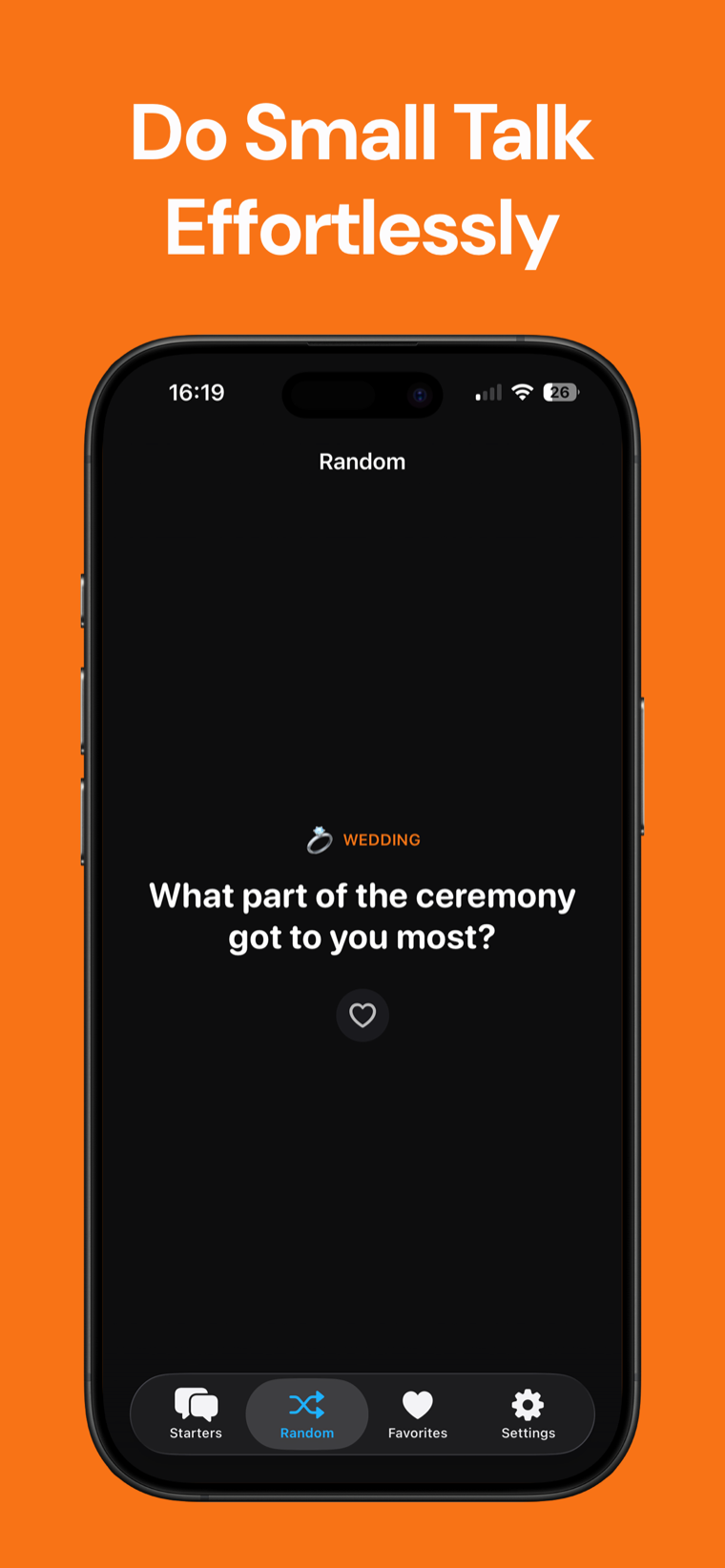
Icebreaker turns conversation practice into a small, repeatable daily habit.

How this social intelligence test is scored
This is an educational self-assessment, not a diagnostic or clinically validated test. Its eight original scenarios represent observable conversation choices rather than personality traits or mental-health symptoms.
Each answer awards 0, 1, or 2 points in one of four domains: social cue recognition, listening, conversational reciprocity, and response choice. Each domain has two questions and a maximum of 4 points. The overall score is the sum of all four domains, with a maximum of 16.
A higher practice score means your selected responses more often used the conversational behavior named by the rubric. It does not measure intelligence, worth, intent, or how you act in every real situation.
Domain score = points on its two scenarios (0–4); overall practice score = all eight scenario points (0–16) Use the lowest domain as a practice prompt, not a label. Context, culture, access needs, and personal boundaries can all change what a helpful response looks like.
Frequently asked questions
Is this a diagnostic social intelligence test?
No. It is an educational, non-diagnostic self-assessment with an original and transparent scoring rubric.
What does the overall score mean?
It summarizes how often your selected answers aligned with four conversation practices in these eight scenarios. It is not a standardized norm or comparison with other people.
Can I improve a domain score?
Yes. Choose one suggested behavior, practice it in low-pressure conversations, and retake the assessment as a reflection exercise.
Why are there no personality labels?
The tool focuses on specific, observable choices that can be practiced instead of assigning a fixed type.
Do culture and context affect the answers?
Yes. Conversation norms vary. The suggested choices are general-purpose options, not universal rules, and personal safety and boundaries come first.