
Funny conversation starters
Funny conversation starters work because humor lowers the stakes fast — a shared laugh signals that neither person is taking the interaction too seriously, which makes it easier to keep talking. The safest version is self-deprecating or observational, not aimed at the other person.
Why humor works as an icebreaker
A joke does something a straightforward question can't: it immediately signals tone. Where a sincere opener leaves some ambiguity about how seriously to take the exchange, a light, funny line makes it obvious that the interaction is meant to be easy and low-pressure. That's a big part of why funny conversation starters tend to get a warmer, faster response than a neutral one — the other person doesn't have to guess how much effort or vulnerability is expected of them.
Humor also makes an opener memorable. A generic "how's it going" blends into every other interaction someone's had that night; a genuinely funny line stands out enough to be worth remembering, which matters if you're hoping the conversation goes somewhere.
The tradeoff is that humor carries more delivery risk than an earnest question. A joke that lands as playful from one person can read as sarcastic or try-hard from another — tone and timing do a lot of the work, which is worth keeping in mind before leaning on humor as your only approach. It also skews easier in settings that already signal fun is on the agenda — a party or a bar gives a joke more room to land than a quiet, formal setting would.
Funny conversation starters for parties
Parties are the easiest setting for funny conversation starters because the whole environment already signals that the mood is meant to be light.
- "Okay, be honest — how many times did you almost bail on coming tonight?"
- "I need a second opinion: is this playlist good, or are we all just being polite?"
- "If you had to leave this party right now and never come back, what would your excuse be?"
- "What's the most chaotic party you've ever been to? This one doesn't count — yet."
- "I'm going to guess what you majored in based on vibes alone. No pressure."
These work because they're observational — about the party itself, not about the other person — which keeps the risk low even if the joke doesn't fully land.
Bar conversation starters
Bars come with their own built-in material: the drink someone's holding, the line at the bar, the music, the general chaos of the room.
- "I'm trying to decide what to order — you look like someone with strong opinions about that."
- "What's the worst drink you've ever ordered with total confidence?"
- "Be honest, is this your regular spot, or are you also just wandering in?"
- "If this bar had a theme song, what do you think it'd be?"
- "What's your go-to excuse for ordering water when you're actually just tired?"
Lines that reference the shared moment — the wait, the noise, the crowd — tend to land better than ones that require a longer setup, since attention spans in a loud room are shorter than usual.
Funny conversation starters for casual hangouts
Everyday, lower-key settings — a coffee shop, a waiting room, running into someone you sort of know — call for something a little more understated than party-level energy, but still light.
- "I've been standing here debating this decision for way too long — help me out?"
- "What's the most useless skill you're weirdly proud of?"
- "If you could instantly swap lives with a fictional character for a day, who's the pick?"
- "What's a food combination you love that everyone else thinks is wrong?"
- "Rate this weather on a scale of one to ten. Be honest, I can take it."
Funny conversation starters for a group
Humor works a little differently when you're addressing several people at once instead of one — a group is more forgiving of a joke that doesn't fully land, since there are more people to react and someone usually picks it up.
- "Quick poll: is this the good side of the room, or did we pick wrong?"
- "Someone settle this for me — is pineapple on pizza a crime or a preference?"
- "What's the most confidently wrong opinion anyone here holds? Don't all speak at once."
- "If this group had to survive a group project together, who's doing all the work?"
Addressing the group rather than one person also spreads the pressure to respond across everyone, which makes it an easier way to break into a cluster of people than a one-on-one line would be.
How to deliver a funny line so it actually lands
The line matters less than the delivery. A few things make funny conversation starters land more reliably:
- Keep it light, not sharp. Self-deprecating or observational humor is far safer than anything aimed at the other person, especially with someone you've just met — a joke at someone else's expense can read as mean even when it's meant as playful.
- Deliver it like you mean it, not like you're performing it. A joke said with genuine, easy energy lands better than one that sounds rehearsed or overly pleased with itself.
- Smile, but don't oversell it. Laughing at your own joke before the other person has reacted can undercut it — give it a beat to land.
- Read the room's baseline energy first. A high-energy joke can feel jarring in a quieter setting; match the room before you try to shift it.
- Have a graceful recovery ready. If a joke doesn't land, a quick, easy pivot ("okay, tough crowd — I'll workshop that one") usually gets a laugh anyway and keeps things moving.
When humor doesn't land
Not every joke gets a laugh, and that's normal — timing, mood, and personal taste all play a role that has nothing to do with the line itself. If a funny opener falls flat, the easiest recovery is to shift into something more straightforward rather than trying to explain or salvage the joke. A simple, genuine follow-up question moves things along without dwelling on the misfire. For a broader set of openers to fall back on beyond humor, our guide to conversation starters for any situation covers openers sorted by setting, mood, and context.
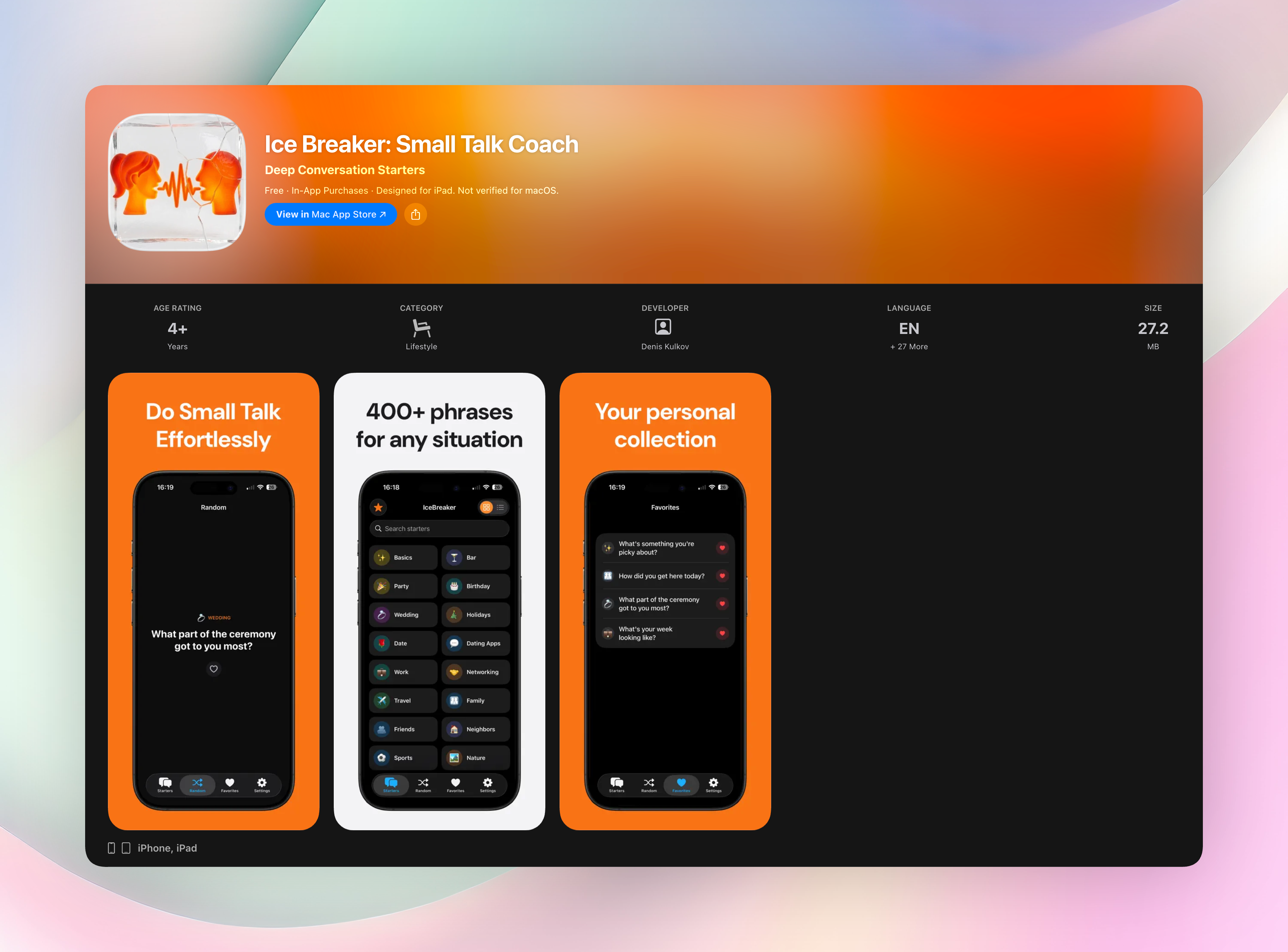
If you want a stash of lighter, funnier lines ready for the next party or bar night instead of hoping one comes to you, Ice Breaker is a free app with 480 conversation starters across 16 categories, including lighthearted ones, with a favorites list for whichever style tends to work for you.
FAQ
What are some funny conversation starters for a party?
Observational, party-specific lines tend to work best — something about the music, the crowd, or the general chaos of the night. They're low-risk because they're about the shared moment, not about the other person.
What are good bar conversation starters?
Lines that reference something already happening — the drink line, the music, the noise — tend to land well because they don't require much setup, which matters in a loud, distracted environment.
How do I make a joke land when meeting someone new?
Keep it self-deprecating or observational rather than aimed at the other person, deliver it with easy confidence instead of over-explaining it, and give it a beat to land before reacting yourself.
What if my funny conversation starter doesn't get a laugh?
It happens, and it's rarely personal — timing and mood matter as much as the line itself. A light, easy pivot to a more straightforward question keeps the conversation moving without dwelling on the miss.
Is humor a good way to start a conversation with someone you're attracted to?
It can work well because it lowers the pressure for both people, but keep it playful rather than edgy, and be ready to follow up with a genuine question once the laugh lands — humor works best as an opener, not the entire conversation.
Free Ice Breaker tools
- Conversation Starter GeneratorChoose your relationship, setting, and tone to get a low-pressure opener plus a natural follow-up question.
- Get to Know You Worksheet MakerChoose a group, audience, depth and question count. Add your own prompts or use the visible built-in question bank.
- How Well Do They Know Me Quiz MakerChoose a group, category, difficulty and question count. Add personal questions or use the visible built-in bank.
- Icebreaker GeneratorChoose your group, headcount, and time window to get a practical icebreaker with simple instructions and a realistic duration.
- Social Intelligence TestReflect on eight everyday scenarios to see practice scores for cue recognition, listening, conversational reciprocity, and response choice.