
Conversation starters for dating apps
The best conversation starters for dating apps reference something specific from the other person's profile — a photo, a prompt answer, a stated interest — rather than a generic greeting. Specific openers get replies because they give the other person something concrete to react to.
Conversation starters for dating apps: why "hey" doesn't work
A message with nothing in it — "hey," "hi," "how's it going" — asks the other person to do all the work of finding something to talk about. On a dating app, where most people are managing several conversations at once, a message that requires effort to answer is the easiest one to skip entirely. It's not that these openers are rude; they're just forgettable, and forgettable loses to specific in an inbox full of messages.
The fix is simple in principle: reference something actually in front of you. Every profile has at least one detail — a photo, a prompt answer, a listed interest — that's easier to build a message around than a blank greeting.
Profile-based conversation starters
These work because they show you actually read the profile, not just swiped on a photo.
- React to a specific photo. "Okay, the [activity/location] photo — what's the story there?" works better than a general compliment because it points at something concrete.
- Respond to a prompt answer. If their profile includes a written prompt, react to it directly: "Your answer to [the prompt] made me laugh — is that a real story or an exaggeration?"
- Ask about a stated interest. "You mentioned you're into [hobby/show/hometown] — how'd that start?"
- Disagree lightly, if there's room to. A playful, low-stakes disagreement ("Hard disagree on [an opinion in their profile] — convince me") tends to get more replies than agreement does, because it invites a response rather than just an acknowledgment.
- Ask a genuine follow-up on something unusual. If one detail stands out as unique, that's usually the strongest thing to open with — it's the detail most likely to have an interesting story behind it.
Conversation starters for online dating with a sparse profile
Some profiles don't give you much to work with — a few photos, no prompts, minimal bio. In that case, lean on what is there rather than defaulting to a generic line.
- "What's the story behind your profile photo — was that a trip, or just a good day?"
- "Your bio's short and to the point — what's one thing it's not telling me?"
- "What got you on here — new to the area, taking a break from dating apps and back again, or just seeing what's out there?"
These still ask about something specific to their profile (even the absence of detail counts) rather than defaulting to a completely generic opener.
The follow-up matters more than the opener
A strong opener gets a reply, but the follow-up is what actually builds a conversation worth continuing. The same follow-up-question habit that works in any conversation applies here: pick a specific detail from their reply and ask about it, rather than sending a new, unrelated question. If someone replies to a photo question with a quick story, ask about a detail inside that story rather than moving straight to a new topic — it signals you're actually reading their messages, not just cycling through a script.
It also helps to keep your own messages roughly matched in length and effort to theirs. A one-line reply to a paragraph-length message (or the reverse) tends to create a mismatch that's hard to recover from — matching energy keeps the exchange feeling balanced.
Signs the conversation is worth continuing, or isn't
Not every match turns into a great conversation, and it's worth reading the signals rather than pushing through a flat exchange out of habit.
- Response time and length trending down over several messages usually means interest is fading, even if the tone stays polite.
- Questions coming back the other way are a strong signal of genuine interest — a conversation that's entirely you asking and them answering rarely goes anywhere.
- Matching energy and humor — if your playful messages get short, flat replies, the chemistry may just not be there, which is normal and not worth overanalyzing.
- A conversation that's stayed purely surface-level after many messages is often a sign it's time to suggest meeting, since some things only become clear in person.
Moving from app chat to a real conversation
A conversation that stays in the app for too long tends to lose momentum — messages get shorter, replies get slower, and the initial spark fades before you've actually talked. A few things help keep it moving toward an actual conversation or date:
- Keep the early exchange light but responsive. A few genuine back-and-forth messages that actually build on each other matter more than a long single message that doesn't leave room for a reply.
- Suggest moving off the app once there's real back-and-forth. "This is a fun conversation — want to keep it going over text?" or suggesting a call works well once a few solid exchanges have happened.
- Don't over-invest before meeting. Weeks of daily texting before a first date can build expectations that the actual meeting struggles to live up to — a shorter runway from match to date tends to go better.
- Suggest a specific plan, not just "we should hang out." A concrete suggestion ("There's a coffee place near [area] — want to check it out this weekend?") is easier to say yes to than an open-ended one.
Once you're actually meeting up, the same fundamentals as any date apply — see conversation starters for couples for first-date-specific openers once the conversation moves offline.
Conversation starters to avoid on dating apps
A few patterns reliably hurt your odds of getting a reply:
- Compliments only about looks. These are among the most common messages people get and the easiest to skip, precisely because they say nothing specific about the person.
- Negging or backhanded openers. Anything that reads as a subtle put-down, even meant as playful, tends to read as a red flag rather than charming.
- Copy-paste openers. A message that could apply to literally any profile signals you didn't actually read theirs.
- Anything overly familiar too fast. Pet names or intense compliments before a single real exchange has happened tend to feel presumptuous rather than flattering.
- A wall of text as the first message. A long opening message asks for more effort in return than most people are willing to give a stranger's first message.
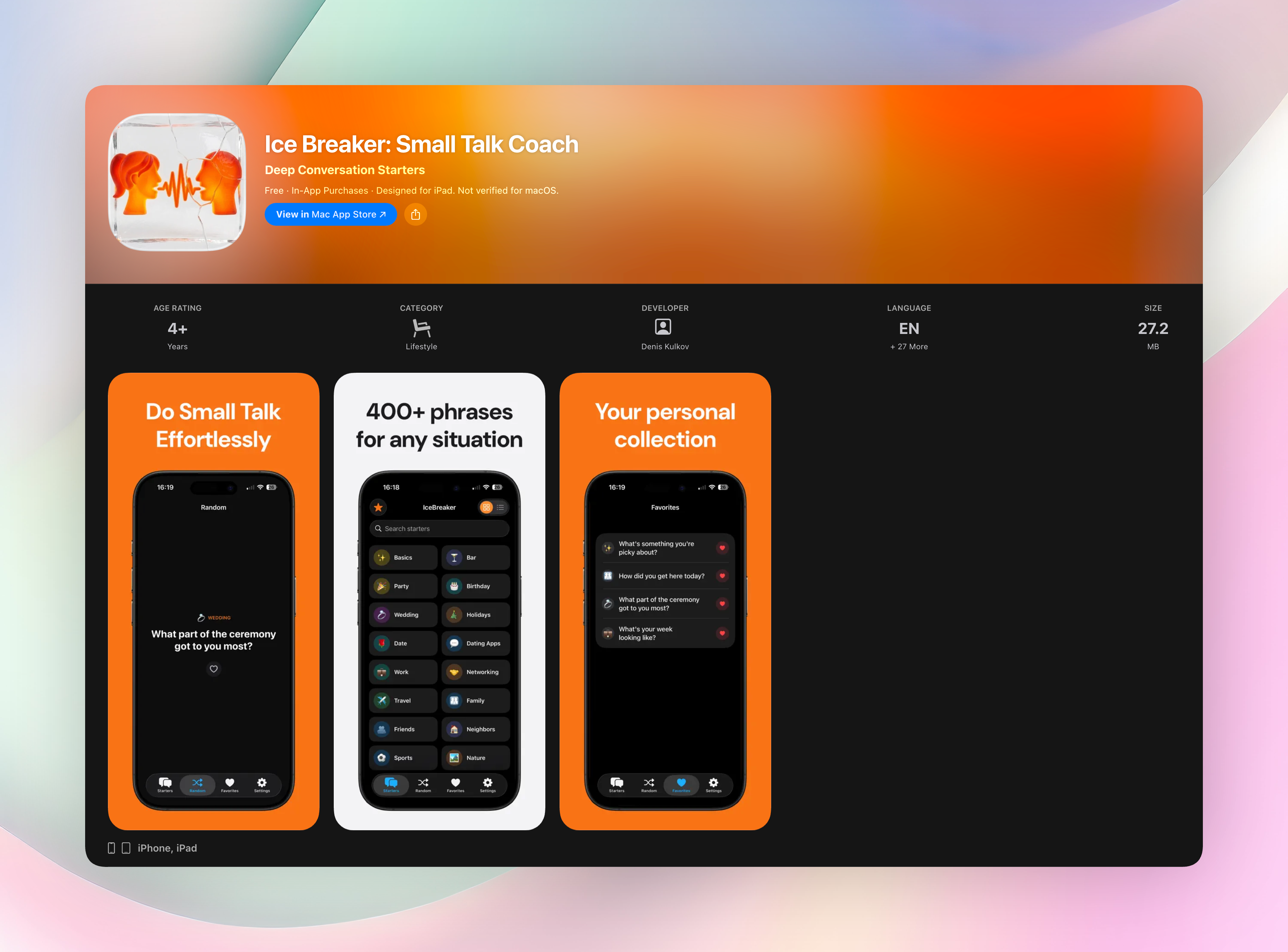
If you'd rather have a stash of ready-made lines than compose a new opener for every match, Ice Breaker is a free app with 480 conversation starters across 16 categories, so you have a starting point to adapt to whatever's actually in front of you on a given profile.
FAQ
What's a good first message on a dating app?
A message that references something specific in the other person's profile — a photo, a prompt answer, a stated interest — tends to get far more replies than a generic "hey," because it gives them something concrete and easy to respond to.
Why do my dating app messages get ignored?
Generic openers ask the other person to supply all the effort themselves, which is easy to skip in an inbox full of messages. Referencing something specific from their profile, and asking a genuine question rather than just complimenting a photo, tends to get much better response rates.
How long should I chat on a dating app before suggesting a date?
There's no fixed number, but once you've had a few genuine back-and-forth exchanges, it's usually worth suggesting a call or a date rather than letting the conversation drag on for weeks — momentum tends to fade the longer it stays purely text-based.
What should I avoid saying in a dating app conversation starter?
Skip looks-only compliments, copy-paste-sounding openers, and anything overly familiar before a real exchange has happened. These tend to signal low effort or read as presumptuous rather than genuine interest.
Is it okay to disagree with something in someone's profile as an opener?
A light, playful disagreement can actually work well — it invites a real response rather than a flat "thanks." The key is keeping it low-stakes and clearly good-natured rather than combative.
Free Ice Breaker tools
- Conversation Starter GeneratorChoose your relationship, setting, and tone to get a low-pressure opener plus a natural follow-up question.
- Get to Know You Worksheet MakerChoose a group, audience, depth and question count. Add your own prompts or use the visible built-in question bank.
- How Well Do They Know Me Quiz MakerChoose a group, category, difficulty and question count. Add personal questions or use the visible built-in bank.
- Icebreaker GeneratorChoose your group, headcount, and time window to get a practical icebreaker with simple instructions and a realistic duration.
- Social Intelligence TestReflect on eight everyday scenarios to see practice scores for cue recognition, listening, conversational reciprocity, and response choice.