
Icebreaker questions for team building
The best icebreaker questions for team building stay professional but low-stakes — work-adjacent enough to feel appropriate for the setting, personal enough to actually reveal something. What works in a meeting differs from what works at an onboarding session or a networking event, so the register matters as much as the question itself.
Icebreaker questions for team meetings
A quick icebreaker before a meeting starts can shift the energy in the room without eating much time, as long as it stays short and optional.
- "What's one win from this week, big or small?"
- "What's something you're looking forward to outside of work this week?"
- "If you could automate one part of your job, what would it be?"
- "What's the best thing you've eaten this week?"
- "What's a tool or shortcut that's made your week easier?"
Keep meeting icebreakers to sixty seconds a person at most — the goal is a quick reset before the real agenda, not a full round of storytelling. A written or chat-based version works just as well as saying it out loud, which is useful for meetings where not everyone has their camera or mic on.
Icebreaker questions for new-hire onboarding
Onboarding icebreakers do double duty: they help a new hire feel welcome and give the existing team quick, memorable details to attach to a new name.
- "What made you want to join the team?"
- "What's something you're hoping to learn in your first few months here?"
- "What's a fun fact about you that isn't on your resume?"
- "What's your ideal way to spend a weekend?"
- "What's one thing you'd want the team to know about how you like to work?"
That last one is worth including even though it's more practical than fun — it gives new hires an easy, low-pressure way to share working-style preferences (communication style, focus time, meeting habits) that usually take months to surface otherwise.
Icebreaker questions for team building activities and offsites
Offsites and dedicated team-building sessions can go a little deeper than a quick meeting opener, since there's usually more time and a more relaxed setting.
- "What's a skill outside of work you're proud of?"
- "What's the most interesting job you've had before this one?"
- "What's a piece of advice that's stuck with you professionally?"
- "What's something about you that would surprise the rest of the team?"
- "If the team had a mascot, what should it be and why?"
For a wider set of question formats and a few lightweight games to run them in — Two Truths and a Lie, Human Bingo, and similar — see our guide to get to know you questions. Most of those formats translate directly to a work offsite; just keep the specific questions professional in tone.
Icebreaker questions for remote and hybrid teams
Remote teams miss the incidental small talk that happens naturally in a shared office, so a deliberate icebreaker matters more, not less, when most contact happens over video.
- "What's the view from your workspace today?"
- "What's something on your desk that tells a story?"
- "What's your go-to background noise while you work — music, silence, something else?"
- "What's one thing that's made working from wherever you are easier?"
- "What's a local spot near you that's worth visiting if a coworker were ever in town?"
Keep remote icebreakers shorter than in-person ones — video calls tire people out faster, so two or three quick rounds land better than a long go-around, especially at the start of a meeting people are already trying to get through.
Icebreaker questions to avoid at work
A handful of categories create more discomfort than connection in a professional setting, even when well-intentioned:
- Anything touching family, marital status, or plans to have kids. These can unintentionally single out someone or edge into legally sensitive territory depending on where you are.
- Health and finances. Even framed lightly, these can feel invasive or put someone in an awkward spot in front of coworkers.
- Political or religious topics. These carry real potential for friction in a setting people can't easily opt out of.
- Anything that requires revealing a weakness. "What's something you're bad at?" can feel like it's setting someone up rather than inviting genuine sharing, especially early in a working relationship.
- Questions with a clear right answer for the company. "What do you love most about working here?" on day one reads as performative rather than genuine — save authentic feedback questions for after some real experience has built up.
Conversation starters for coworkers
Day-to-day small talk with coworkers — hallway chats, break room moments, the first few minutes of a call — works best with topics that maintain the relationship without requiring anyone to get personal.
- "How's your week shaping up?"
- "Got anything good going on outside of work?"
- "How'd that project end up going?" (following up on something they mentioned before)
- "Any good recommendations lately — shows, food, anything?"
- "What's on your desk/screen that most people wouldn't guess?"
The follow-up matters more than the opener here — remembering and asking about something a coworker mentioned last week does more for the relationship than any new question could. It's also worth keeping a light rotation of go-to topics rather than defaulting to the same one every time; work, food, and weekend plans each open different territory, and switching between them keeps the day-to-day chat from going stale.
Networking conversation starters
Networking events call for a different register than internal team icebreakers — you're usually talking to strangers, often with an unspoken professional agenda in the room, which can make the exchange feel transactional if you're not careful.
- "What brought you to this event?"
- "What are you working on that you're excited about right now?"
- "What's the most interesting thing you've heard so far today?"
- "How'd you get into this industry?"
- "What's something you're hoping to learn or find here?"
The most effective networking conversation starters lead with curiosity about the other person's work rather than an opening pitch about your own — people respond better to genuine interest than to a rehearsed introduction, and it usually earns the same curiosity back. Save the business card exchange for the end of the conversation, once there's an actual reason to stay in touch.
Tips for running icebreakers at work
- Keep it optional. Nothing kills the energy of a work icebreaker faster than someone visibly forced to answer a question they're uncomfortable with. A quick "pass if you'd rather not" removes that pressure.
- Time-box it. A minute or two per person is usually the ceiling before a meeting icebreaker starts eating into the actual agenda and people start disengaging.
- Match the depth to the setting. A quick standup opener should stay lighter than a dedicated offsite session — save the more reflective questions for when there's actually time for them.
- Avoid questions that touch on personal circumstances. Family status, health, and finances are off-limits in a professional icebreaker, even when meant well — stick to preferences, interests, and work-adjacent topics instead.
- Rotate who's asked to go first. Always starting with the same person (often the most senior one) can unintentionally set the tone for how much everyone else feels comfortable sharing.
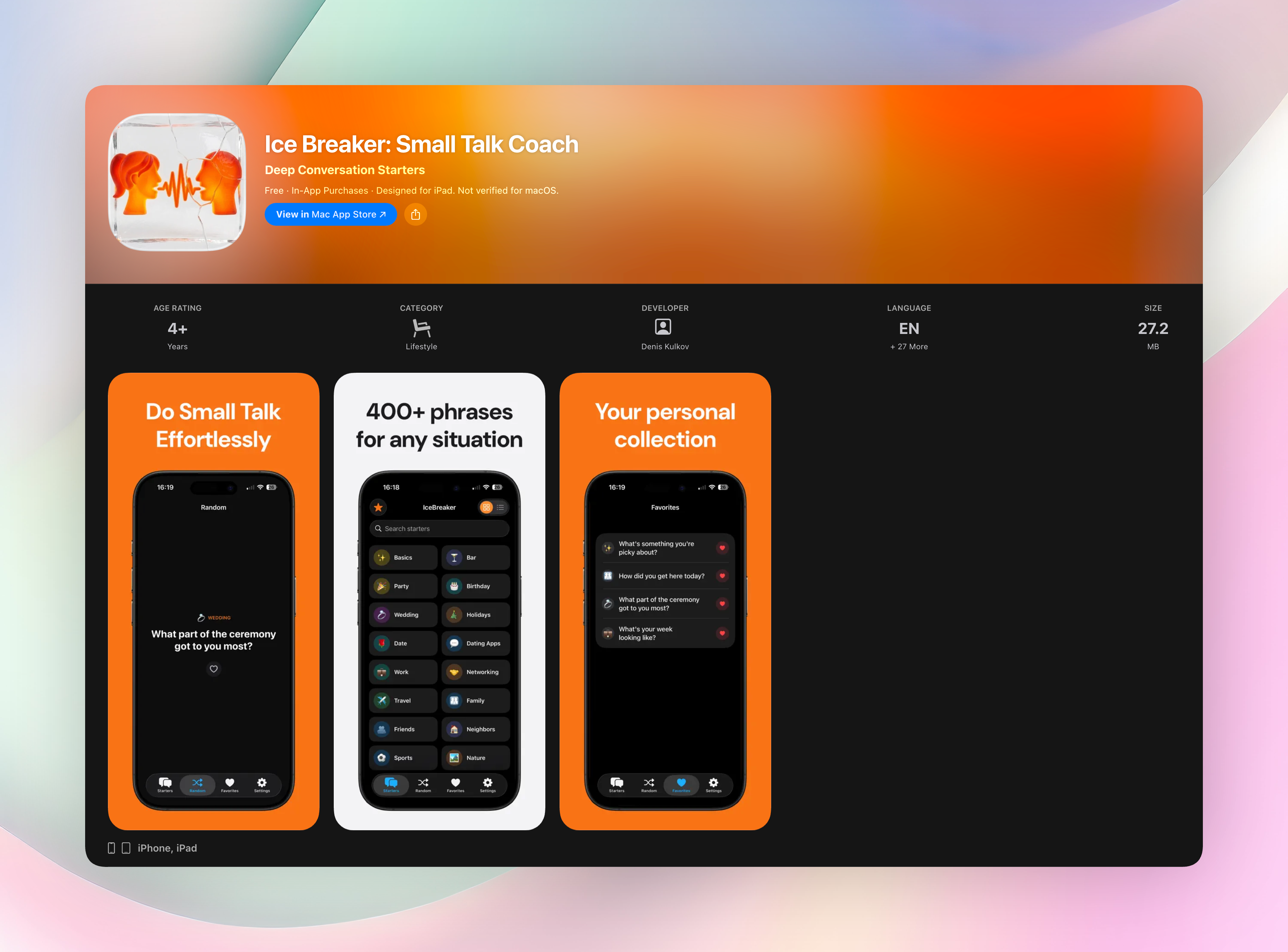
If you find yourself blanking when it's your turn to suggest an icebreaker or start a conversation at a work event, Ice Breaker is a free app with 480 conversation starters across 16 categories, so you have something ready to pull up instead of scrambling for a question on the spot.
FAQ
What are good icebreaker questions for team building?
Questions that stay work-adjacent but reveal something personal — a proud skill, an interesting past job, a fun fact — tend to work best, because they're professional enough for the setting without feeling like an interrogation.
What icebreaker questions work well for a quick work meeting?
Short, low-effort ones: a weekly win, something to look forward to, or a favorite recent meal. Keep it under a minute per person so it doesn't eat into the actual meeting.
How do I start a conversation at a networking event without sounding like I'm pitching myself?
Lead with a genuine question about what the other person is working on or what brought them to the event. Curiosity about them reads better than an opening pitch about yourself, and it usually gets returned.
How long should a work icebreaker take?
For a regular meeting, aim for sixty to ninety seconds per person at most. Dedicated onboarding sessions or offsites can run longer, but even then, a hard time limit keeps the energy from dragging.
Are icebreakers actually useful, or just a waste of meeting time?
Used sparingly and kept short, they do real work — they give a team small, low-pressure details to remember about each other, which makes everyday collaboration a little smoother. Overused or dragged out, they start to feel like filler, which is usually a sign to cut the time in half rather than cut them entirely.
Free Ice Breaker tools
- Conversation Starter GeneratorChoose your relationship, setting, and tone to get a low-pressure opener plus a natural follow-up question.
- Get to Know You Worksheet MakerChoose a group, audience, depth and question count. Add your own prompts or use the visible built-in question bank.
- How Well Do They Know Me Quiz MakerChoose a group, category, difficulty and question count. Add personal questions or use the visible built-in bank.
- Icebreaker GeneratorChoose your group, headcount, and time window to get a practical icebreaker with simple instructions and a realistic duration.
- Social Intelligence TestReflect on eight everyday scenarios to see practice scores for cue recognition, listening, conversational reciprocity, and response choice.