
What is small talk?
Small talk is light, low-stakes conversation about safe, shared topics — weather, weekend plans, the event you're both at — used to establish comfort before a conversation goes anywhere deeper. It's not filler; it's the groundwork that makes the next, more meaningful exchange possible.
What is small talk?
Small talk is the category of conversation that trades depth for safety. It covers things nobody has to think hard about or risk anything to answer: how someone's week is going, whether they've tried the coffee here, how bad the traffic was. The subject matter isn't the point — the exchange itself is. Two people are signaling, through a low-risk back-and-forth, that they're willing to be friendly toward each other.
The small talk meaning people usually reach for — "meaningless chit-chat" — undersells what it's doing. It's less about the words and more about the function: establishing tone, checking that both people are open to talking, and building a small amount of trust before either person commits to anything heavier.
Why is small talk important?
Small talk matters because most real conversations don't start at the deep end — they warm up into it. Jumping straight to a personal or substantial topic with someone you've just met skips the step where both people decide the other is safe to talk to. Small talk is that step. It's low-cost enough that either person can bail without awkwardness, which is exactly what makes it a safe way to test the waters.
There's a practical, social-function reason small talk shows up everywhere from elevators to conference lobbies to first dates: it's a shared ritual with predictable rules. Both people know roughly what's expected, which lowers the anxiety of the interaction. That predictability is also why small talk gets a bad reputation — it can feel scripted — but the script exists because it works reliably across strangers who have nothing else in common yet.
Small talk also does real relationship maintenance beyond first meetings. A quick "how was the weekend" with a coworker you see daily isn't about the weekend; it's a small deposit that keeps the relationship warm without requiring either of you to invest real time or vulnerability.
Small talk vs big talk
"Big talk" is the term often used for the opposite end of the spectrum: conversation with real stakes — values, fears, ambitions, relationships, things that reveal who someone actually is. The difference isn't just topic, it's exposure. Small talk risks almost nothing; big talk asks you to say something that could be judged, disagreed with, or misunderstood.
| Small talk | Big talk | |
|---|---|---|
| Typical topics | Weather, weekend, current event, the room you're in | Values, fears, relationships, opinions that matter to you |
| Risk to either person | Very low | Higher — invites judgment or disagreement |
| Function | Establishes safety and rapport | Builds real connection and understanding |
| Where it shows up | First meetings, elevators, queues, networking | Established friendships, dates past the first one, late-night talks |
Neither mode is better — they serve different jobs. Small talk vs big talk isn't a hierarchy to climb as fast as possible; it's a sequence. Skipping small talk to go straight to big talk with a stranger tends to feel invasive rather than intimate, because the safety hasn't been built yet.
Common misconceptions about small talk
A few ideas about small talk get repeated so often they start to sound like fact, even when they don't hold up.
"Small talk is fake." It can feel scripted, but scripted isn't the same as insincere. Asking about someone's weekend doesn't require you to be obsessed with their weekend — it's a genuine offer of attention, delivered through a low-effort format both people understand.
"Only extroverts are good at small talk." Small talk rewards curiosity and a willingness to speak first more than raw sociability. Plenty of quieter people are excellent at it because they're genuinely interested in the answer, not because they enjoy talking for its own sake.
"Small talk is a waste of time." This one misses what small talk is actually for. It's not meant to be efficient or information-dense — its value is in the rapport it builds, which is what makes the efficient, substantive conversation later possible at all.
"You either have it or you don't." Small talk is closer to a habit than a fixed trait. Like any habit, the awkwardness fades with repetition — the tenth conversation with a stranger is rarely as stiff as the first.
When small talk is expected
A few settings run almost entirely on small talk, and knowing the pattern makes them easier:
- Waiting situations — lines, elevators, waiting rooms — where the interaction is brief and small talk fills the space without demanding much.
- The opening minutes of any first meeting — a job interview, a first date, meeting a partner's family — before the "real" conversation starts.
- Workplace hallway moments — small talk with coworkers maintains a working relationship without either person needing to open up.
- Networking events, where small talk is often the entire point: it's how people gauge whether a deeper business conversation is worth having.
In each of these, trying to skip straight past small talk usually reads as awkward or overeager, even when the intent is good.
Moving from small talk into something more
Small talk isn't meant to be the whole conversation — it's the on-ramp. Once it's flowing comfortably (a few easy exchanges, some genuine reactions, maybe a laugh), that's usually the signal that it's safe to ask a slightly more personal question and let the conversation go deeper. If you want a stock of lines to start that on-ramp in the first place, our guide to conversation starters for any situation breaks them down by setting.
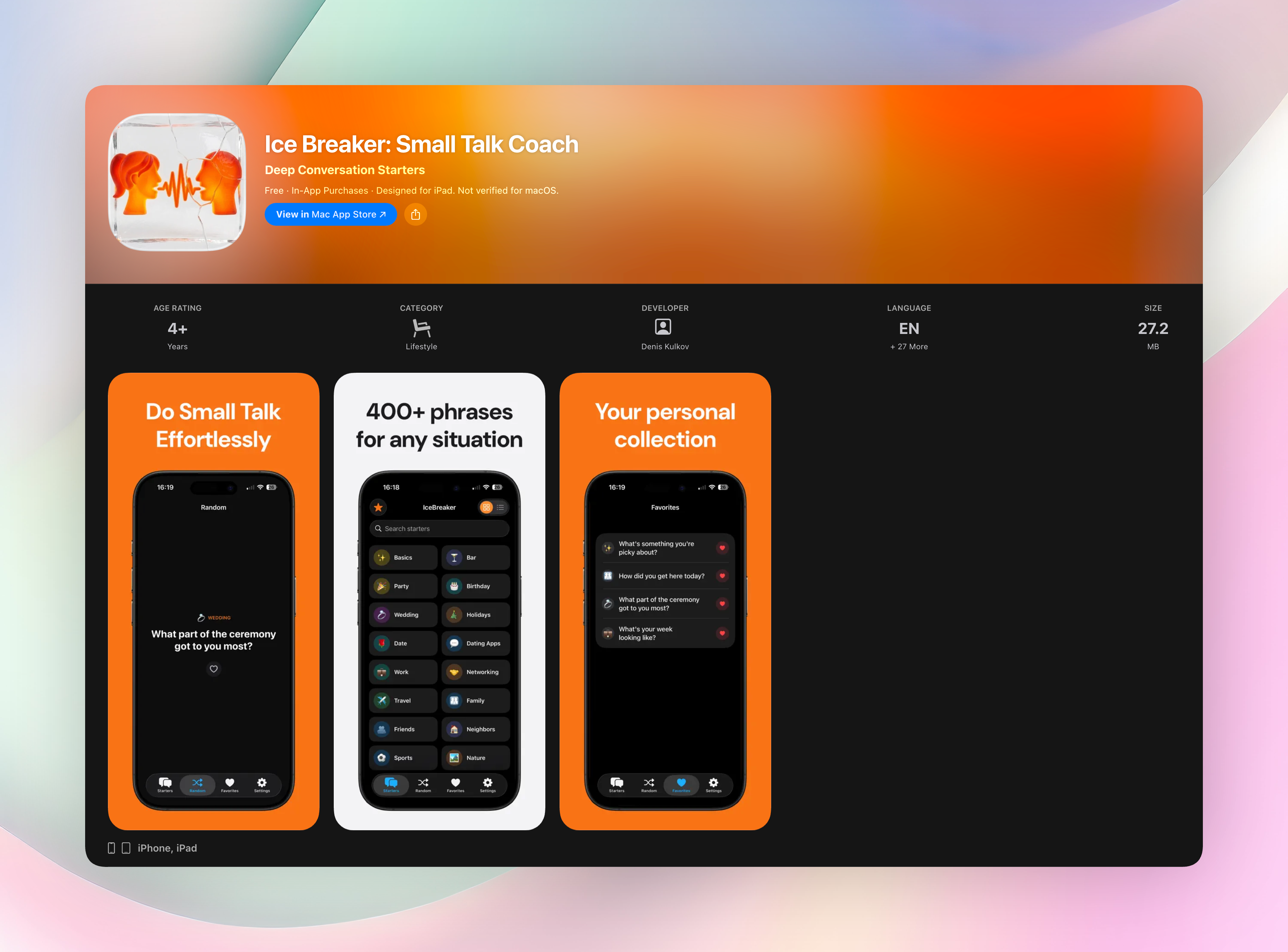
If you tend to blank on what to say in that opening stretch, Ice Breaker is a free app with 480 conversation starters across 16 categories, built for exactly that moment — searchable offline, with a favorites list for the ones that work for you.
FAQ
What is small talk exactly?
Small talk is brief, low-stakes conversation about safe shared topics — weather, plans, the immediate setting — used to build comfort and signal friendliness before a conversation moves anywhere more personal.
Why is small talk important if it feels meaningless?
It feels meaningless because the topic doesn't matter much, but the function does: it establishes that both people are safe to talk to and willing to engage, which is the groundwork almost every deeper relationship is built on.
What's the difference between small talk and big talk?
Small talk covers low-risk topics that don't reveal much about you; big talk covers values, feelings, and opinions that carry real stakes. Small talk usually has to come first because it builds the trust that makes big talk feel safe rather than invasive.
Is small talk the same as flirting?
Not inherently — small talk is simply low-stakes conversation, which can happen in a flirtatious context or a completely neutral one, like a checkout line or a work meeting. The tone depends on the setting and the people, not the format itself.
How long should small talk last before moving to a deeper topic?
There's no fixed length — it depends on how quickly both people seem comfortable. A few easy exchanges with genuine reactions on both sides is usually a reasonable signal that it's safe to ask something a little more personal.
Free Ice Breaker tools
- Conversation Starter GeneratorChoose your relationship, setting, and tone to get a low-pressure opener plus a natural follow-up question.
- Get to Know You Worksheet MakerChoose a group, audience, depth and question count. Add your own prompts or use the visible built-in question bank.
- How Well Do They Know Me Quiz MakerChoose a group, category, difficulty and question count. Add personal questions or use the visible built-in bank.
- Icebreaker GeneratorChoose your group, headcount, and time window to get a practical icebreaker with simple instructions and a realistic duration.
- Social Intelligence TestReflect on eight everyday scenarios to see practice scores for cue recognition, listening, conversational reciprocity, and response choice.