
Conversation starters for family
Good conversation starters for family gatherings ask about the present and the future — plans, memories, small updates — rather than reopening old topics or assuming everyone shares the same politics. The best ones work across generations: a teenager, a parent, and a grandparent can all answer them comfortably.
Why family gatherings need their own approach
Family conversations carry history that a room of strangers doesn't. That history can make small talk easier in some ways — there's already a foundation of shared context — but it also means certain topics come loaded in ways they wouldn't with someone new. A question that seems neutral to one person might brush up against an old disagreement, a sensitive life stage, or a running family joke that's actually not that funny to the person it's about.
The generational gap adds another layer. A conversation starter that lands well with a grandparent (a question about the past, a family tradition) can feel irrelevant to a teenager, and a question that works well with a teenager (something about school, friends, what they're into) can feel like small talk beneath a grandparent's attention. Good conversation starters for family gatherings work by leaning on what's actually universal — plans, memories, small updates — rather than assuming one register fits everyone in the room.
Conversation starters for family gatherings
These work broadly across ages and relationships, which makes them useful defaults at a holiday table or reunion.
- "What's something you're looking forward to before we all see each other again?"
- "What's the best thing that's happened to you since the last time we talked?"
- "What's a memory from a past gathering like this one that always makes you laugh?"
- "Has anyone tried [a dish on the table] yet? What do you think?"
- "What's something new you've picked up or gotten into recently?"
- "What's a family tradition you'd want to make sure keeps going?"
These questions ask about the present or a shared, positive past — territory that's comfortable for nearly everyone at the table, regardless of age or how close the relationship is.
Conversation starters for teens
Teenagers often get a narrow set of questions at family gatherings — school, grades, college plans — which can feel more like an evaluation than a conversation. A few alternatives tend to open things up more:
- "What's something you're really into right now that most adults probably don't know about?"
- "What's the funniest thing that's happened at school lately?"
- "If you could skip one class forever, which one and why?"
- "What's a show, game, or artist you think more people should know about?"
- "What's something you're actually excited about these days?"
The common thread is asking about interest and enthusiasm rather than performance. A teenager is far more likely to open up about something they're genuinely into than about their GPA, and the resulting conversation is usually a lot more interesting for both sides.
Conversation starters for parents and grandparents
Older relatives often respond well to questions that invite a story, since stories are an easier and more natural format than being asked to state an opinion outright.
- "What's your favorite memory from when you were my age?"
- "What's something you wish you'd known when you were younger?"
- "What's a family story you think the younger generation hasn't heard yet?"
- "What's the best piece of advice anyone's ever given you?"
- "What's something that's surprised you about how things have changed over the years?"
These questions work well because they treat the person's experience as worth hearing about in detail, not just as a fact to note in passing.
Conversation starters for in-laws and extended family
In-laws and extended family sit in an unusual middle ground — not strangers, but not quite as familiar as immediate family either, which means some of the shared-history assumptions from earlier in this guide don't apply as cleanly.
- "What's been the highlight of your year so far?"
- "Is there a tradition on your side of the family we should adopt over here?"
- "What's something you're proud of that doesn't come up much at these gatherings?"
- "What's a recommendation you'd give — a place, a show, anything — that we probably haven't heard yet?"
These treat the relationship more like a warmer version of meeting someone new — personal enough to build real rapport, general enough not to assume history that isn't actually there yet.
Bridging generations at the table
A few conversation starters work especially well specifically because they invite different generations to compare notes rather than talk past each other.
- "What was a typical Saturday like for you at my age?" (a teen asking a grandparent, or vice versa)
- "What's something that used to be a big deal that barely matters anymore?"
- "What's a piece of technology you couldn't imagine your life without now?"
- "What's a rule or expectation from when you were growing up that seems wild looking back?"
These naturally surface the differences between generations in a way that tends to produce laughter and genuine curiosity rather than a lecture in either direction. For a broader set of question categories that also work well at a family gathering — food, hobbies, current events — see our guide to small talk topics.
Topics to avoid at family gatherings
A handful of topics reliably turn a warm gathering tense, especially with extended family who don't see each other often enough to have an established rhythm for handling disagreement.
- Politics and religion, especially anything currently in the news — these carry more risk of real conflict at a family table than with strangers, precisely because everyone has a stake in staying in each other's lives afterward.
- Money and comparisons — salaries, home prices, who's doing better than whom — tend to create quiet resentment even when nobody says anything directly.
- Relationship status and family planning — "when are you settling down" or "when are you having kids" assumes a timeline that might be painful or simply none of the table's business.
- Old arguments or family history that's still sensitive — resurfacing a past conflict, even lightly, rarely goes as smoothly as it seems like it might in the moment.
- Comparisons between family members — "why can't you be more like your cousin" territory shuts down warmth fast, even when meant as a joke.
If a topic has caused tension at a past gathering, it's usually not worth testing again, even years later.
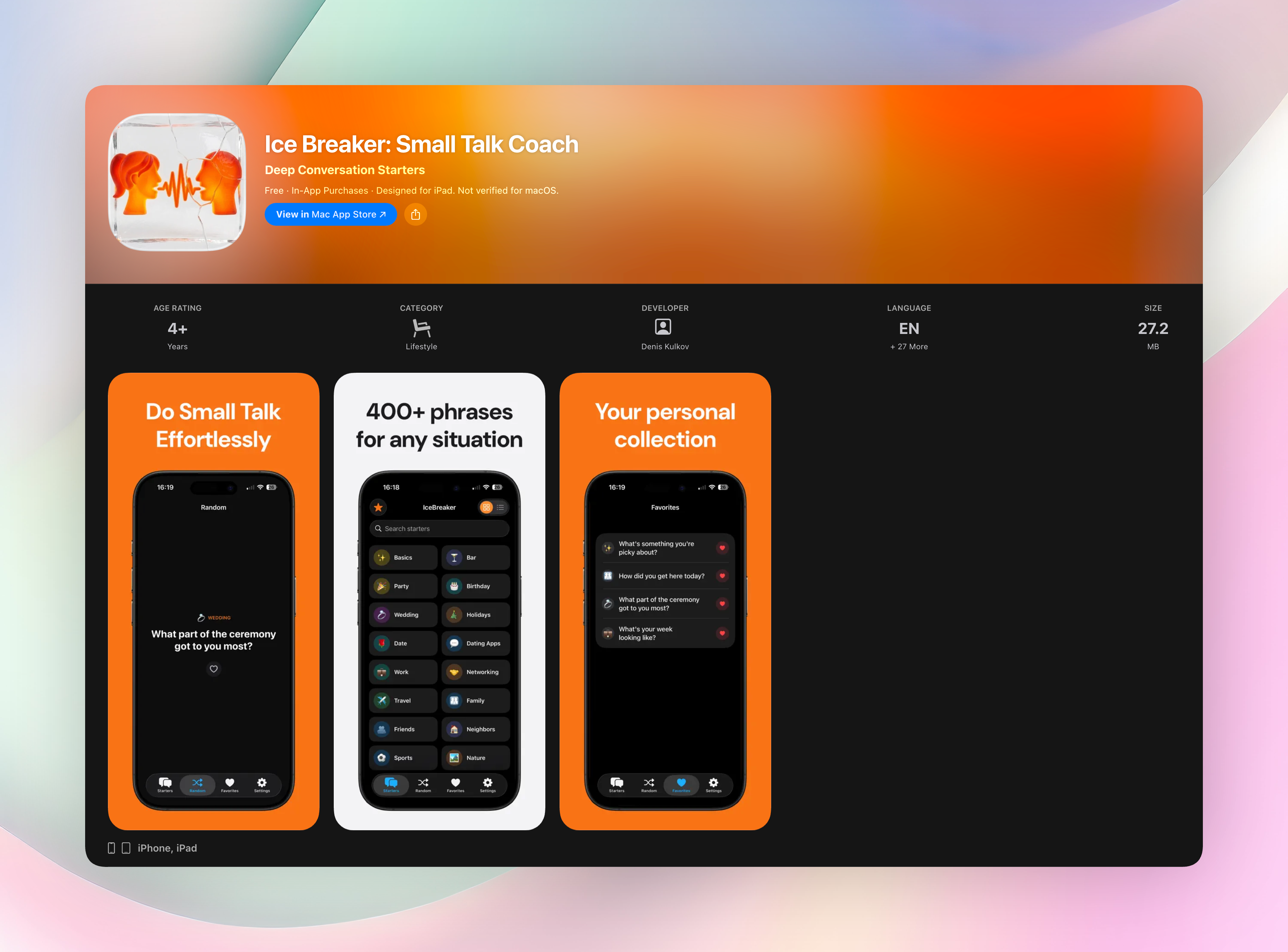
If you find yourself blanking on what to bring up once the usual updates run out, Ice Breaker is a free app with 480 conversation starters across 16 categories, so you have a few fresh ones ready before the next holiday or reunion instead of relying on the same handful every time.
FAQ
What are good conversation starters for a family gathering?
Questions about the present or a shared, positive memory tend to work best across ages — plans, recent updates, or a favorite memory from a past gathering. These stay comfortable for nearly everyone at the table.
What are good conversation starters for teens at a family event?
Questions about what they're genuinely into — a show, a hobby, something funny that happened recently — tend to open teenagers up more than school or grade-focused questions, which can feel like an evaluation rather than a conversation.
How do I talk to my grandparents about something other than the same old stories?
Ask about a specific era or moment rather than a general "how are you" — a favorite memory from their own youth, or something that's surprised them about how things have changed, tends to invite a fresher story than a broad question would.
What topics should be avoided at family gatherings?
Politics, religion, money, relationship status, and old family conflicts tend to create the most tension, especially with extended family who don't see each other often enough to navigate disagreement smoothly.
How do I bridge the generation gap in conversation at family events?
Questions that invite comparison between eras — what a typical day looked like at the same age, or what's changed the most — tend to work well, since they turn the age gap itself into something to talk about rather than a barrier.
Free Ice Breaker tools
- Conversation Starter GeneratorChoose your relationship, setting, and tone to get a low-pressure opener plus a natural follow-up question.
- Get to Know You Worksheet MakerChoose a group, audience, depth and question count. Add your own prompts or use the visible built-in question bank.
- How Well Do They Know Me Quiz MakerChoose a group, category, difficulty and question count. Add personal questions or use the visible built-in bank.
- Icebreaker GeneratorChoose your group, headcount, and time window to get a practical icebreaker with simple instructions and a realistic duration.
- Social Intelligence TestReflect on eight everyday scenarios to see practice scores for cue recognition, listening, conversational reciprocity, and response choice.